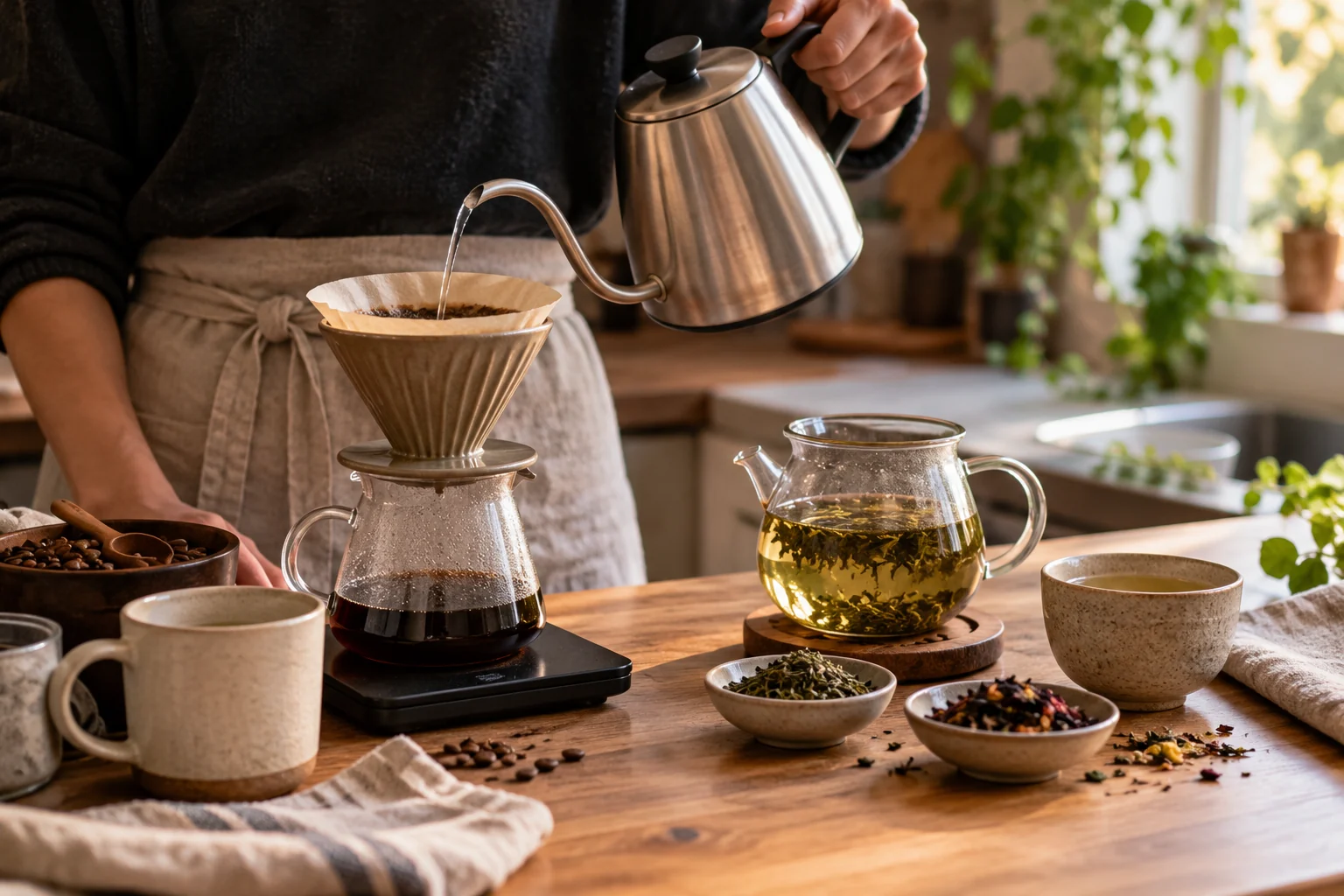
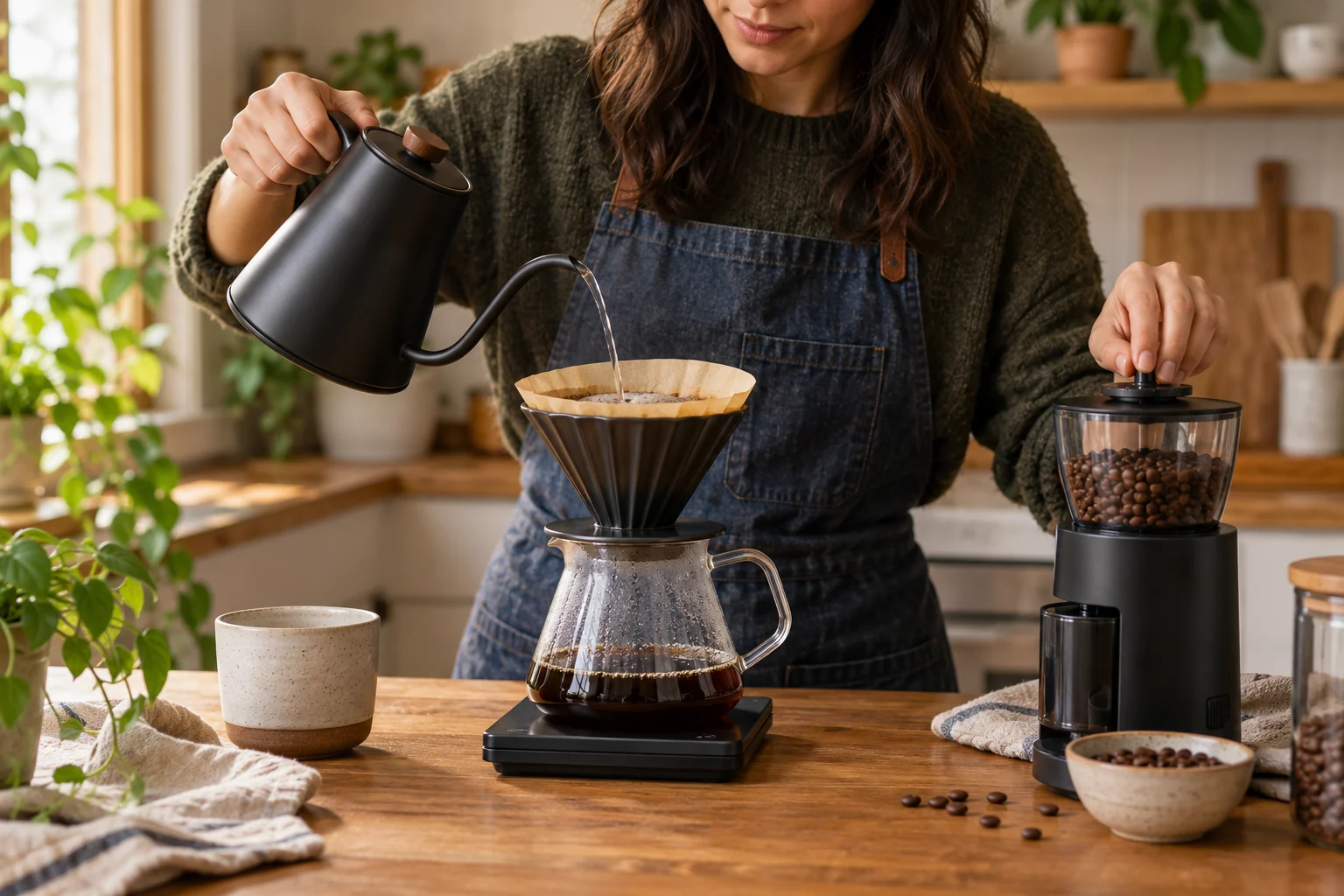
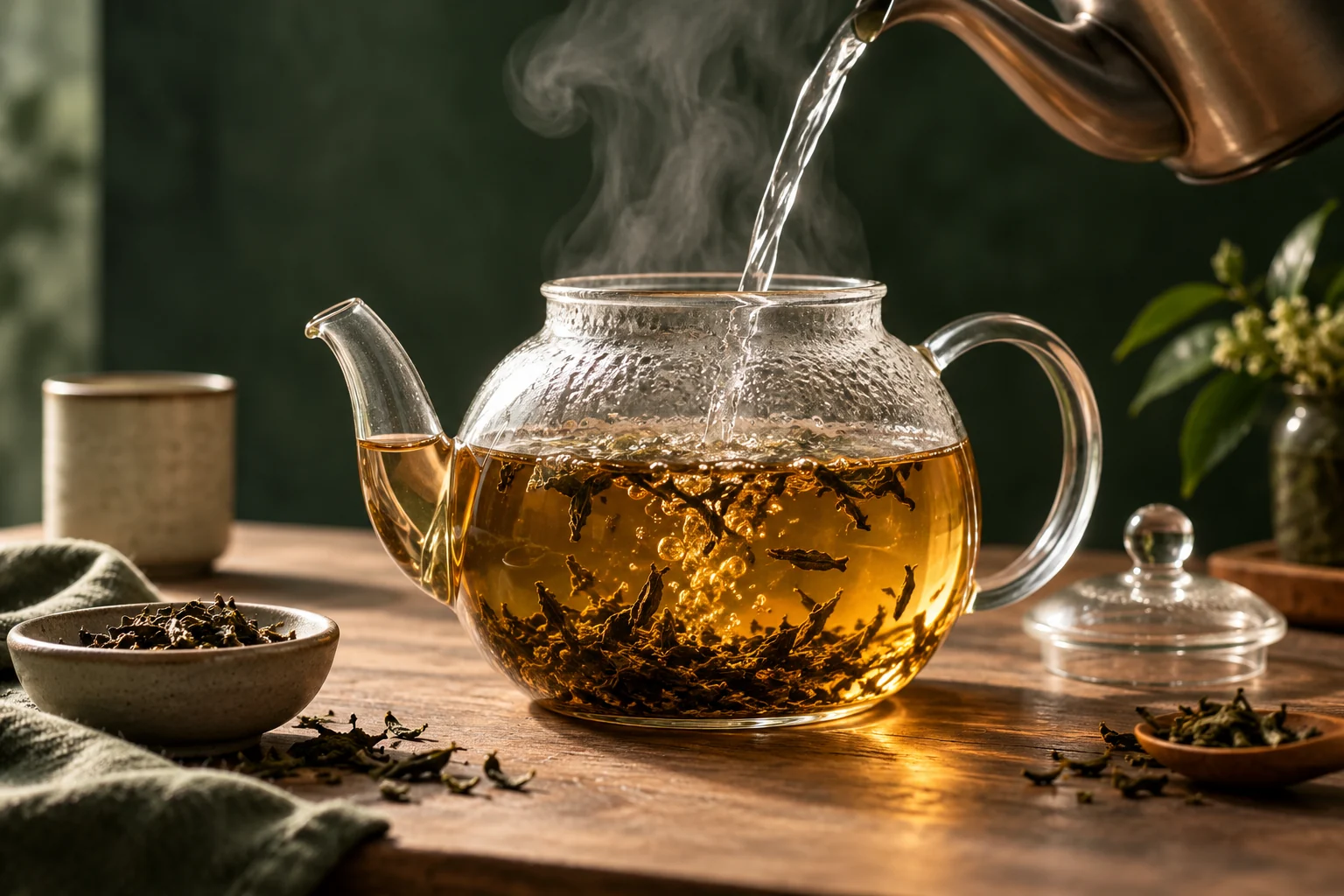
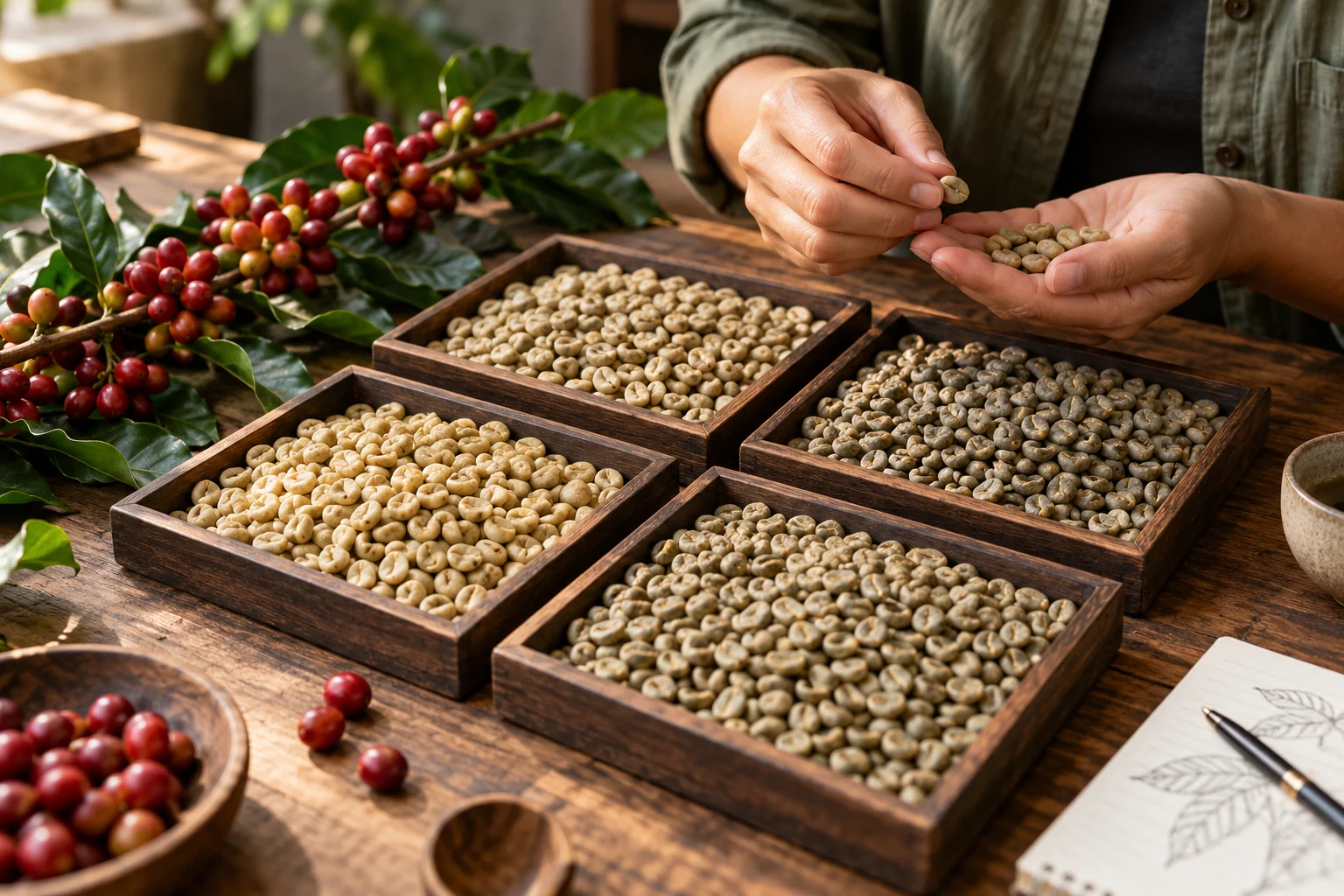
Learn the basics of coffee and tea, including plants, processing, brewing, tasting, storage and the best next guides to explore.
Coffee and tea can both become complicated fast. You start by wanting a better morning drink and suddenly people are talking about cultivars, oxidation, extraction, grind distribution, water chemistry and brewing traditions.
You do not need to master all of that to make a better cup.
The useful starting point is simpler: understand what you are brewing, learn which variables matter, then change one thing at a time.
The short answer
Coffee is brewed from roasted seeds of coffee fruit. True tea comes from the leaves of Camellia sinensis.
Both are shaped by plant genetics, growing environment, harvest, processing, storage, water and brewing technique.
The main difference is what happens before the drink reaches you. Coffee seeds are processed, dried and roasted. Tea leaves are processed through combinations of withering, heating, rolling, oxidation, drying and, for some dark teas, microbial post-fermentation.
Coffee starts with a fruit
A coffee bean is the seed inside a coffee fruit.
After harvest, producers process and dry the seeds. Roasters then transform green coffee through heat.
Two species dominate commercial production: Arabica and Robusta, the common name for Coffea canephora. Within those species are many cultivated varieties.
Our coffee varieties guide explains the difference between species, cultivar and origin.
Tea starts with one plant and many processing paths
Green, white, yellow, oolong, black and dark tea can all come from Camellia sinensis.
Their differences come largely from cultivar, growing conditions and processing.
Herbal infusions such as chamomile and peppermint are commonly called tea in everyday language, but botanically they are not true tea because they do not come from Camellia sinensis.
Start with our tea varieties guide if you want to understand the major categories.
Roast and oxidation are different ideas
Coffee roast level and tea oxidation are often treated as if they mean the same thing.
They do not.
Coffee is roasted after the seed has been dried. Tea categories are created through processing of the fresh leaf before it reaches the drinker.
A dark-roast coffee and a black tea can both look dark, but they got there through different chemistry and processing.
Brewing is controlled extraction
Both coffee and tea use water to dissolve and carry flavor into the cup.
The practical controls are familiar:
- amount of coffee or tea
- amount of water
- water temperature
- contact time
- particle or leaf size
- movement or agitation
You do not need perfect numbers. You need repeatable starting points.
Coffee grind size is a major control
Grinding changes surface area and, in many methods, water flow.
That is why espresso, pour-over, drip and French press use different grind ranges.
Use our grind-size guide as a starting point, then adjust by taste.
Tea leaf size changes brewing too
Tea does not use a grinder, but leaf form still matters.
Broken leaves and fannings often infuse quickly. Whole leaves may open more slowly and can behave differently across repeated infusions.
That does not make one form automatically better. It means the leaf should match the brewing experience you want.
Temperature is a starting point, not a sacred number
Both coffee and tea guides love exact temperatures.
Useful ranges improve consistency, but no single number works for every coffee, tea or method.
For coffee, see our temperature guide. For tea, see how to brew the perfect cup of tea.
Ratio makes recipes repeatable
Measuring what you use is one of the easiest ways to improve both drinks.
You do not need laboratory precision. If you know roughly how much coffee or tea you used with how much water, you can repeat a good cup or troubleshoot a bad one.
Consistency matters more than owning expensive gear.
Coffee brewing methods create different experiences
Common methods include drip, pour-over, French press, espresso, moka pot and cold brew.
Each changes the interaction of grind, filtration, pressure and contact time.
If you want a practical first step, start with Brew Better Coffee.
Tea brewing can be just as varied
Tea can be brewed in a mug, basket infuser, teapot, gaiwan or specialized vessel.
Some styles use one longer infusion. Others use repeated short infusions.
Neither approach is universally better.
Our oolong guide and matcha guide show how different tea preparation can become.
Tasting does not require expert vocabulary
Start with simple questions:
- Is it sweet, bitter, sour or drying?
- Does the aroma remind you of fruit, flowers, nuts, cocoa, herbs or toasted grain?
- Is the body light, creamy, syrupy or thin?
- Does the finish disappear quickly or linger?
Use our coffee tasting guide and tea tasting guide for structured practice.
Freshness matters differently
Roasted coffee changes relatively quickly after roasting and grinding.
Tea can remain enjoyable longer when stored well, but air, light, moisture, heat and strong odors can damage aroma.
For tea, see our storage guide.
Gear should solve a problem
A burr grinder can make coffee more repeatable. A roomy tea infuser can make loose-leaf brewing easier. A temperature-controlled kettle can be convenient if you frequently switch between different teas.
But equipment should enter the process after you know what problem you are trying to solve.
Brew Sip Repeat does not use product cards simply to fill space. Any future recommendation must be genuinely relevant and Brew-specific within CXM.
Culture matters as much as technique
Coffee and tea are not only extraction problems.
Coffeehouses became major social institutions. Tea developed through centuries of Chinese and wider Asian practice before later European trade, taxation and imperial systems transformed its global scale.
For the broader stories, read the cultural significance of coffee and the evolving history of tea.
Where should a beginner start?
If you mostly drink coffee, learn your current brew method, improve grind consistency, use a repeatable ratio and compare two coffees side by side.
If you mostly drink tea, identify the tea type, start with a sensible temperature and steep time, and compare the same tea with one small change.
If you enjoy both, use the overlap. Notice how each drink responds to water, time and ratio while remembering that coffee roasting and tea processing are fundamentally different.
Bottom line
Coffee and tea are deep subjects, but the fundamentals are approachable.
Learn what plant and category you are drinking. Understand how processing changes it. Use water, ratio, time, temperature and particle or leaf size as practical controls. Taste comparatively. Buy gear only when it solves a real problem.
Then follow the part of the rabbit hole you actually enjoy.