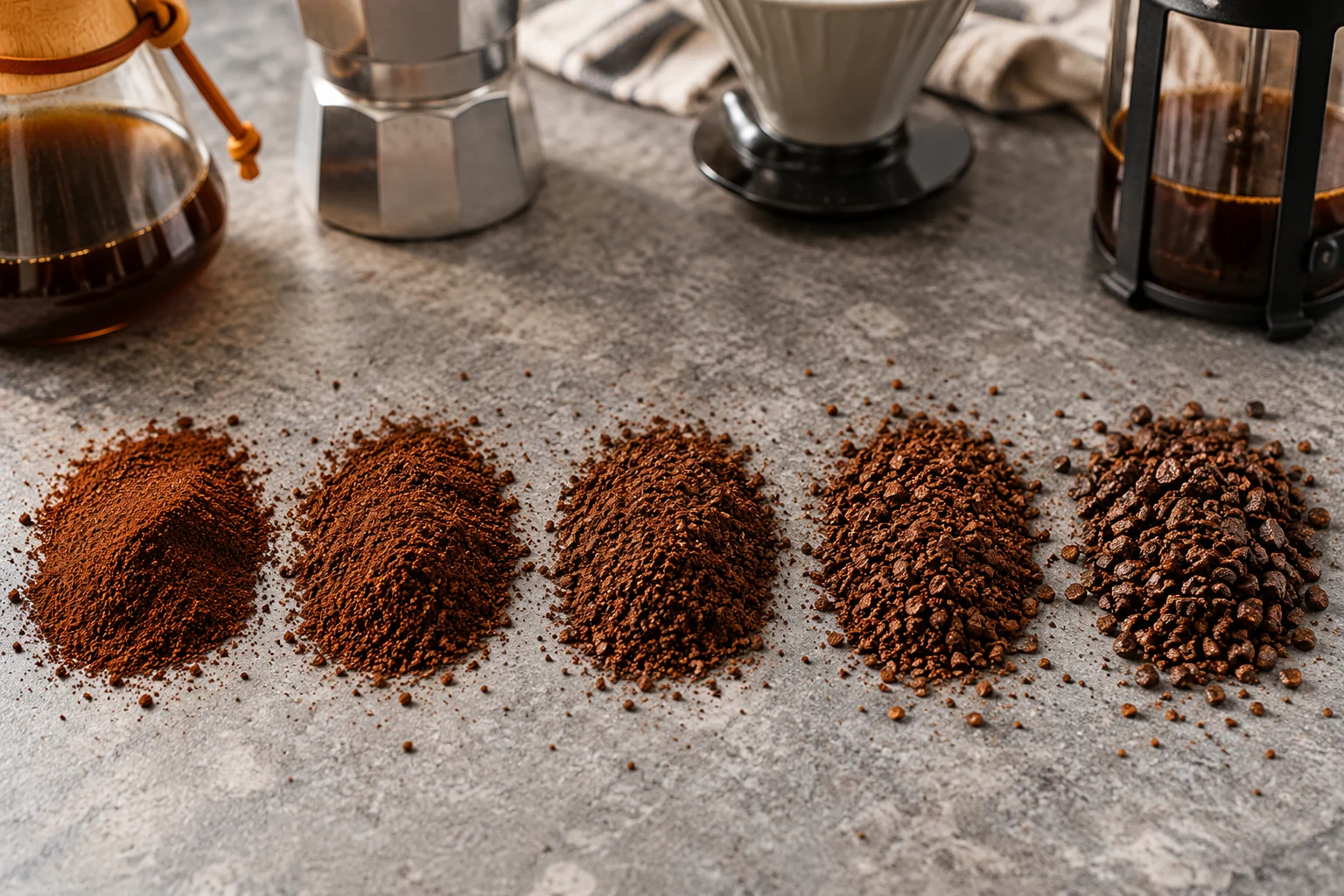
The right grind size is the one that lets your brewing method extract coffee at the right pace. As a starting point, use fine coffee for espresso, medium-fine to medium for most pour-over and drip brewing, medium-coarse to coarse for immersion methods such as French press, and coarse coffee for cold brew.
Those labels are only starting points. Grinder numbers are not standardized, beans behave differently, and even two brewers of the same style may need different settings. The best approach is to start in the expected range, brew, taste, and make one small grind adjustment at a time.
Quick coffee grind size chart
| Brew method | Starting grind | What it should resemble |
|---|---|---|
| Espresso | Fine | Fine sand to table salt, depending on grinder and machine |
| Moka pot | Medium-fine | Finer than drip, coarser than typical espresso |
| Pour-over | Medium-fine to medium | Table salt to sand |
| Automatic drip | Medium | Sand / table salt |
| AeroPress-style brewers | Fine to medium | Recipe-dependent |
| French press | Medium-coarse to coarse | Coarse salt |
| Cold brew | Coarse | Coarse salt / chunky particles |
Treat this as a map, not a rulebook. The final setting depends on brew time, filter, coffee dose, water flow, roast, bean age, and your grinder's particle distribution.
Why grind size changes coffee extraction
Grinding changes how much surface area water can reach and how easily water moves through a bed of coffee.
A finer grind creates more exposed surface area and generally extracts faster. In percolation methods such as espresso and pour-over, finer particles can also slow water flow.
A coarser grind exposes less surface area and usually extracts more slowly. In filter brewing, it often allows water to pass through the coffee bed faster.
That is why grind size is one of the most useful adjustment tools in coffee brewing. It changes both extraction and, in many methods, contact time.
The Specialty Coffee Association's equipment standards use controlled particle-size distributions when evaluating brewers, which is another way of showing that “medium” is not just a visual label; particle distribution materially affects brewing consistency.
Espresso: start fine, then dial in by flow and taste
Espresso uses pressure to move water through a compact coffee bed quickly, so the coffee is typically ground fine.
A practical starting point is to aim for a shot that flows steadily rather than racing through or barely dripping. Breville's current espresso guidance notes that grinding finer generally slows espresso flow, while grinding coarser speeds it up.
If the espresso runs too fast and tastes thin, sharp, or sour, move slightly finer.
If it runs too slowly and tastes harsh, dry, or excessively bitter, move slightly coarser.
Change the grinder in small increments. A minor adjustment can have a noticeable effect on espresso because the brew time is short and the bed offers significant resistance.
Do not copy a grinder number from someone else's machine and assume it will match yours. Burr wear, calibration, roast, humidity, and coffee age all shift the useful setting.
Pour-over: medium-fine is a starting point, not a destination
Most cone and flat-bottom pour-over brewers work somewhere in the medium-fine to medium range.
If your pour-over drains very quickly and tastes hollow, acidic, or weak, try grinding finer.
If it drains much more slowly than expected and tastes drying, dull, or bitter, try grinding coarser.
But grind size is not the only variable. Agitation, filter type, coffee dose, pour pattern, brewer geometry, and water chemistry can all change drawdown and flavor.
That is why the most useful habit is to keep the rest of the recipe steady while you change the grind. If you change dose, water temperature, grind, and pouring technique at the same time, you will not know which change actually improved the cup.
Automatic drip: medium is the safest first move
Automatic drip coffee makers usually perform well with a medium grind, but basket shape and batch size matter.
Breville's consumer brewing guidance also uses medium grind as a general starting point for drip coffee. Specialty Coffee Association certified-brewer testing uses a defined middle particle range to standardize evaluation rather than relying on vague visual labels.
For a large batch, you may need to grind slightly coarser than you would for a smaller batch because the coffee bed is deeper and water spends more time passing through it.
If your drip coffee tastes weak even though you are using enough coffee, do not immediately add more beans. First check whether the grind is too coarse and whether water is moving through the basket too quickly.
French press: coarse, but not boulders
French press is an immersion method. Coffee and water sit together for several minutes, so a coarser grind is a common starting point.
“Coarse” does not mean you should leave giant uneven chunks of coffee in the brewer. Extremely inconsistent grinding can produce a mix of boulders and fines, which makes extraction less predictable.
Start medium-coarse to coarse. If the coffee tastes thin after a normal steep, grind a little finer before dramatically extending the brew time. If it tastes excessively bitter or leaves a heavy layer of fine sediment, a coarser or more consistent grind may help.
A burr grinder is useful here because consistency matters more than chasing an exact visual size.
Cold brew: coarse is usually easiest to manage
Cold brew combines low-temperature water with a long contact time, often many hours. A coarse grind is therefore the most common starting point.
Breville's current consumer grind guidance also places cold brew in the coarse range.
A very fine grind can make cold brew harder to filter and may increase sediment. But going extremely coarse can create a weak concentrate unless you adjust the ratio or steep time.
For cold brew, first decide whether you are making a ready-to-drink beverage or a concentrate. Then keep the coffee-to-water ratio and steep time consistent while you adjust grind.
Related guide: Best Coffee Beans for Cold Brew: How to Choose by Flavor.
Moka pot: do not use an espresso-fine default automatically
Moka pots make concentrated stovetop coffee, but they are not espresso machines. They generally work best with a grind that is finer than typical drip coffee but somewhat coarser than a very fine espresso setting.