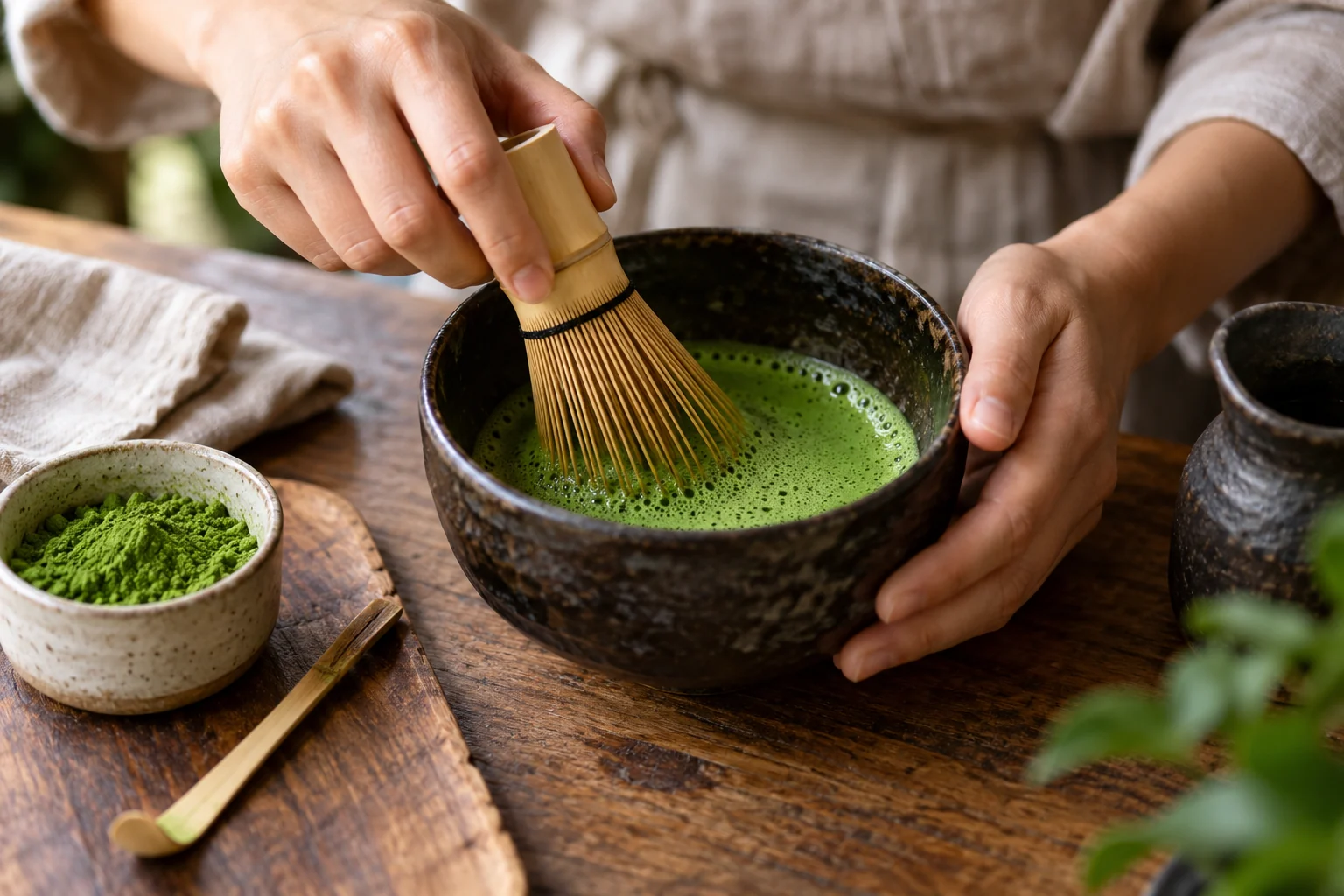
You do not need a formal tea ceremony setup to make a good bowl of matcha at home. The most reliable starting point is simple: sift the matcha, use hot water that is below a full boil, and whisk briskly until the tea is evenly suspended and smooth.
For a classic thin matcha, a useful starting range is about 1.5–2 grams of matcha with 60–80 milliliters of water around 75–85°C (167–185°F). Established Japanese tea producers and educators use slightly different ratios, which is a good reminder that there is no single universal recipe. Start there, then adjust the strength to your taste.
What matcha actually is
Matcha is a powdered Japanese green tea. Unlike a typical loose-leaf tea, where the leaves are infused and removed, matcha is whisked into water and consumed as a suspension.
The tea used for matcha is processed differently from ordinary sencha. Japanese tea organizations describe matcha production as involving steamed leaves that are dried without the rolling step used for sencha, then refined into tencha before grinding. Traditional stone milling produces an extremely fine powder.
That fine particle size is why preparation matters. If you dump matcha directly into water without sifting or mixing it well, dry pockets can survive inside larger clumps.
The easiest reliable matcha recipe
For one bowl of thin matcha, or usucha:
- Warm the bowl. Add hot water to the bowl, briefly soak or rinse the bamboo whisk if you are using one, then discard the water and dry the bowl.
- Sift the matcha. Add about 1.5–2 grams of matcha through a small fine-mesh sifter.
- Add hot water. Start with roughly 60–80 mL of water around 75–85°C (167–185°F).
- Whisk briskly. Move the whisk rapidly back and forth rather than slowly stirring in circles.
- Stop when smooth. For a foamy bowl, continue until a fine layer of bubbles forms across the surface. For a less foamy style, whisk only until evenly suspended.
- Drink promptly. Matcha naturally begins to settle if it sits for a long time.
Ippodo Tea recommends 2 grams of matcha with 60 mL of water at 80°C (176°F) and about 15 seconds of vigorous whisking for its standard usucha. Marukyu Koyamaen gives a starting guideline of approximately 1.5 grams with 70 mL of water in roughly the 70–85°C range depending on season and preference. The Global Japanese Tea Association describes another home method using about 1.2 grams with 70–80 mL of water.
Those differences are not contradictions. They are different starting recipes for a drink that is commonly adjusted for tea, bowl, climate, and personal taste.
Why sifting makes such a difference
Matcha powder is extremely fine and tends to form small clumps during storage. Water can wet the outside of a clump before it reaches the powder in the center, leaving tiny dry pockets that are difficult to break apart once whisking starts.
Passing the matcha through a small sieve before adding water takes only a few seconds and makes the final texture much easier to smooth out.
If your matcha always seems lumpy, fix the dry powder first rather than trying to whisk harder after the water is already in the bowl.
Do you need a bamboo whisk?
A chasen, or bamboo matcha whisk, is the traditional tool and remains one of the easiest ways to create a smooth suspension and fine foam.
Before using a dry bamboo whisk, briefly soften the tines in warm water. That makes them more flexible and reduces the stress of immediately whisking with dry bamboo.
You can still make matcha without a chasen. A small handheld frother, shaker bottle, or tightly sealed jar can disperse the powder. The texture and foam may differ, but the drink can still be enjoyable.
If you use a milk frother, start slowly. A powerful frother can fling a small 60 mL serving out of a shallow bowl surprisingly quickly.
What water temperature is best for matcha?
A full rolling boil is hotter than most classic matcha recipes call for.
For a practical home starting point, aim around 80°C / 176°F. If you do not have a temperature-controlled kettle, boil the water, then transfer it to another cup or measuring vessel and let it cool briefly before pouring it onto the tea.
Cooler water can emphasize sweetness and softness. Hotter water can intensify aroma and flavor, but may also make bitterness or astringency more noticeable depending on the tea.
Treat the temperature as a dial, not a rule carved in stone.
How to whisk matcha without wearing out your arm
The motion matters more than brute force.
Hold the whisk lightly and move mainly from the wrist. Use a quick back-and-forth motion rather than stirring the tea in circles like soup.
Ippodo describes an “M” motion; Marukyu Koyamaen recommends whipping vigorously back and forth while avoiding circular stirring. Both instructions point toward the same practical idea: rapid directional whisking disperses the powder better than slow stirring.
Keep the whisk slightly above the bottom of the bowl once the powder is incorporated. Scraping hard against the ceramic can damage the bamboo tips.
How much foam should matcha have?
Foam is a style choice, not a universal quality score.
Some contemporary matcha service favors a dense layer of tiny bubbles. Other traditions intentionally use little or no foam. Marukyu Koyamaen specifically notes that there are preparation styles that do not raise much foam.
For beginners, a smooth, evenly suspended bowl matters more than chasing a perfect Instagram-ready surface.
Usucha vs. koicha
Most people making matcha at home are preparing usucha, or thin matcha.
Koicha, or thick matcha, is a more concentrated preparation using substantially more matcha and less water. It is mixed more slowly into a thick, glossy texture rather than whipped into a foamy drink.
Ippodo's published koicha method, for example, uses 4 grams of matcha with 30 mL of water at 80°C (176°F), compared with 2 grams and 60 mL for its standard usucha.