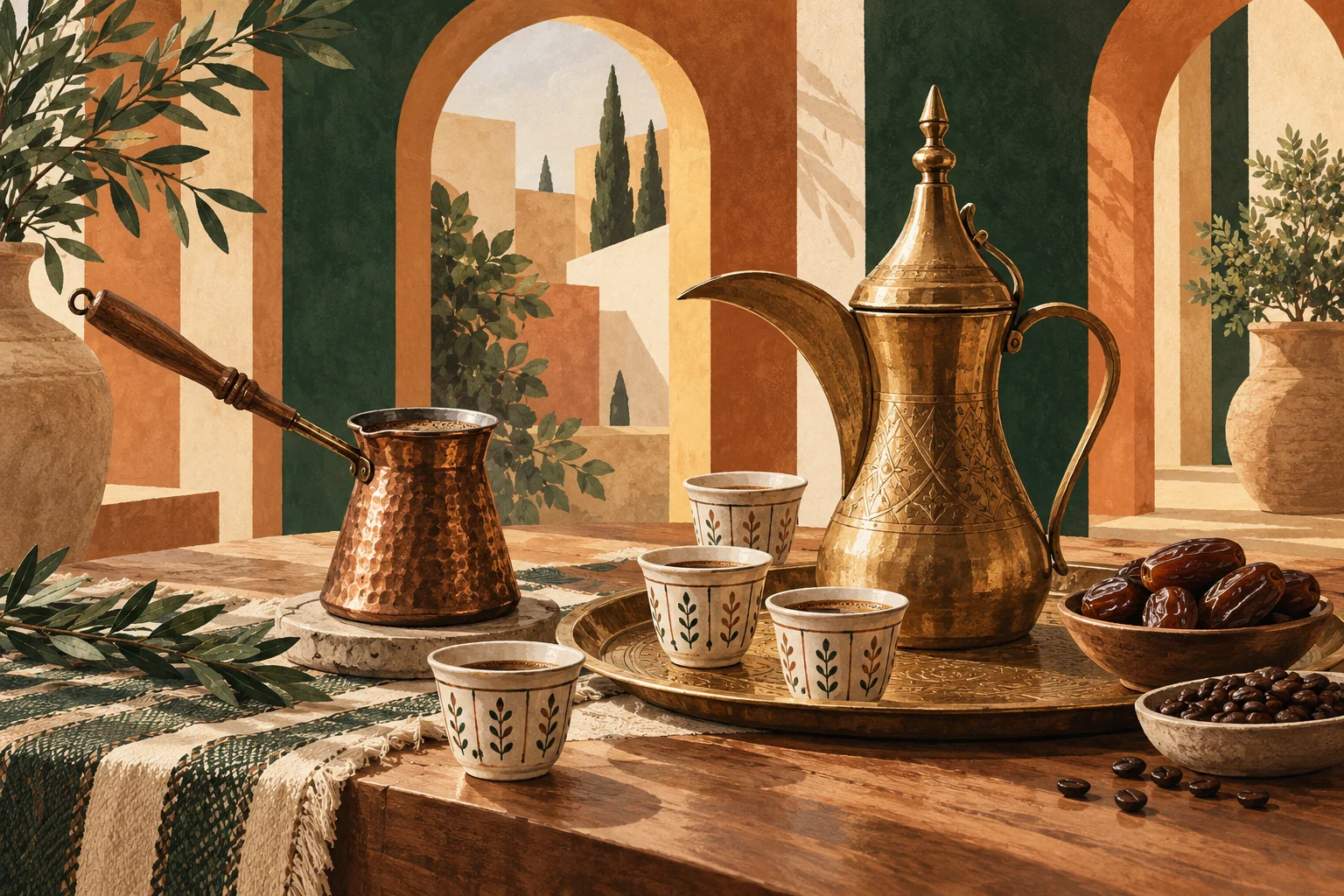

Coffee matters because of more than flavor and caffeine.
Across different places and periods, it has helped organize conversation, hospitality, work, trade, migration and public life. The cup is important, but so are the rooms, rituals and relationships built around it.
That is why the cultural history of coffee cannot be reduced to “coffee brings people together.” Sometimes it did. Sometimes coffeehouses were politically controversial. Sometimes coffee sat inside systems of empire, coerced labor and unequal trade. And sometimes a familiar pot on a family table became a portable piece of home for migrants living far away.
The most useful way to understand coffee culture is to follow the institutions around the drink.
The short answer
Coffee became culturally important because it moved easily between several kinds of social space:
- homes and hospitality rituals
- religiously adjacent gatherings
- commercial coffeehouses
- workplaces and markets
- ports and trade networks
- immigrant communities
- restaurants, diners and cafes
- modern specialty coffee shops
Those spaces gave coffee meaning beyond the beverage itself.
A coffeehouse could function as a place to hear news, arrange work, meet friends or debate politics. A household coffee service could communicate welcome. A migrant family could carry familiar brewing tools across borders. A modern cafe can be a workplace, meeting room, social hub and retail business at the same time.
Coffee culture is therefore not one tradition. It is a collection of local practices connected by a global commodity.
Coffeehouses changed what a beverage could do
Coffee's early spread through the Red Sea and Ottoman worlds eventually produced one of its most durable cultural institutions: the coffeehouse.
By the early modern period, coffeehouses in cities such as Istanbul had become important places of sociability. Historical research describes them as spaces where people exchanged news, told stories, played games, arranged employment and business, and discussed public affairs.
That made the coffeehouse different from simply drinking coffee at home.
A beverage purchase could buy temporary access to a social room.
That pattern would repeat in different forms elsewhere. European coffeehouses, American cafes, neighborhood espresso bars and contemporary specialty shops developed under different political and economic conditions, but they all show how coffee can anchor a semi-public place where people linger.
Our companion story on coffee, religion and culture looks more closely at early devotional use and religious controversy. This article stays focused on the broader social institution.
Why authorities sometimes worried about coffeehouses
Coffeehouse history is often romanticized as an uncomplicated story of brilliant conversation.
The reality was messier.
A place where people gathered to exchange information outside the home could also attract official suspicion. In different periods, rulers and regulators worried about political talk, disorder, licensing and crowds.
That does not mean coffee itself was inherently rebellious.
It means the social infrastructure around coffee could matter politically.
The same room that served leisure could also circulate rumor, news, criticism and employment information. Coffeehouses became culturally significant partly because they created repeatable places for strangers and acquaintances to interact.
Hospitality gives coffee another kind of meaning
Coffee's cultural importance is not limited to public cafes.
In many Arab-speaking communities, for example, coffee service has long been closely connected with hospitality. The Smithsonian's National Museum of American History notes that strong coffee and the tools used to prepare it traveled with migrants from the Middle East to the United States, where familiar grinders and coffee makers could preserve a sense of continuity.
That is a different cultural function from the coffeehouse.
At home, the important elements may include who prepares the coffee, how it is poured, which vessel is used, who is served first, whether spices are added and how long guests remain at the table.
Those details vary by community. They should be described specifically rather than converted into a single generic “Middle Eastern coffee tradition.”
Migration can turn brewing tools into cultural memory
Food and drink often travel with people.
Coffee is especially portable because the practice can be rebuilt with a small set of objects: beans, grinder, brewer, pot and cup.
The Smithsonian's Arab-American coffee pot collection is useful because it shows this material side of migration. Coffee equipment could be among the valued objects migrants carried with them.
A brewing method can therefore become a form of memory.
The same preparation that feels ordinary in one country can become identity-forming in another because it recreates the sensory details of home.
This is one reason coffee culture changes without disappearing. Immigrant communities preserve, adapt and combine practices in new cities.
Coffee became global through trade, not just taste
Coffee's cultural spread depended on commerce.
Plants, beans, brewing knowledge and serving objects moved through trade networks connecting Africa, the Arabian Peninsula, Asia, Europe and the Americas.
That movement created new markets and new drinking cultures, but it also tied coffee to colonial expansion and plantation labor.
A responsible coffee history should not treat global availability as though the drink simply became popular everywhere by consumer choice.
European powers sought control of tropical commodities and built plantation systems around export crops. Across the broader Atlantic plantation economy, enslaved and coerced labor generated enormous wealth from sugar and other commodities consumed alongside coffee, tea and chocolate. Coffee cultivation also became entangled with slavery and colonial labor systems in parts of the Caribbean and Latin America.
The cultural pleasure of the cafe and the economic history of the commodity belong in the same story.
Sweet coffee has its own global history
Coffee is often discussed separately from sugar, but the two commodities became deeply linked in many consumer markets.
The Smithsonian's history of the Atlantic sugar trade documents how enslaved labor powered Caribbean sugar production. Europeans and North Americans increasingly used that sugar to sweeten new hot beverages including coffee, tea and chocolate.
That changes how we should picture an eighteenth- or nineteenth-century coffee table.
The pleasant ritual at one end of the supply chain could depend on brutal labor at another.