Chado and chanoyu are learned through sustained practice, not a single web guide. It is a living discipline studied through practice, teachers, schools and repeated participation.
What a good beginner article can do is explain what the Japanese Way of Tea is, what happens in broad terms, how it differs from simply whisking matcha at home, and how to approach it with respect rather than treating it as a costume or performance.
What is the Japanese tea ceremony?
In English, “Japanese tea ceremony” is a convenient umbrella phrase. In Japanese you will also encounter terms such as chado or sado (“the way of tea”) and chanoyu (“hot water for tea”).
Urasenke, one of the major schools of chado, describes it as a spiritual and aesthetic discipline centered on host and guest sharing time together over a bowl of matcha. The point is not simply to produce a beverage as efficiently as possible.
The preparation, room, utensils, season, food, movement, attention and relationship between host and guests all contribute to the gathering.
That is why this tradition is better understood as a practiced art of hospitality than as a fancy matcha recipe.
Chado is not the same thing as making matcha at home
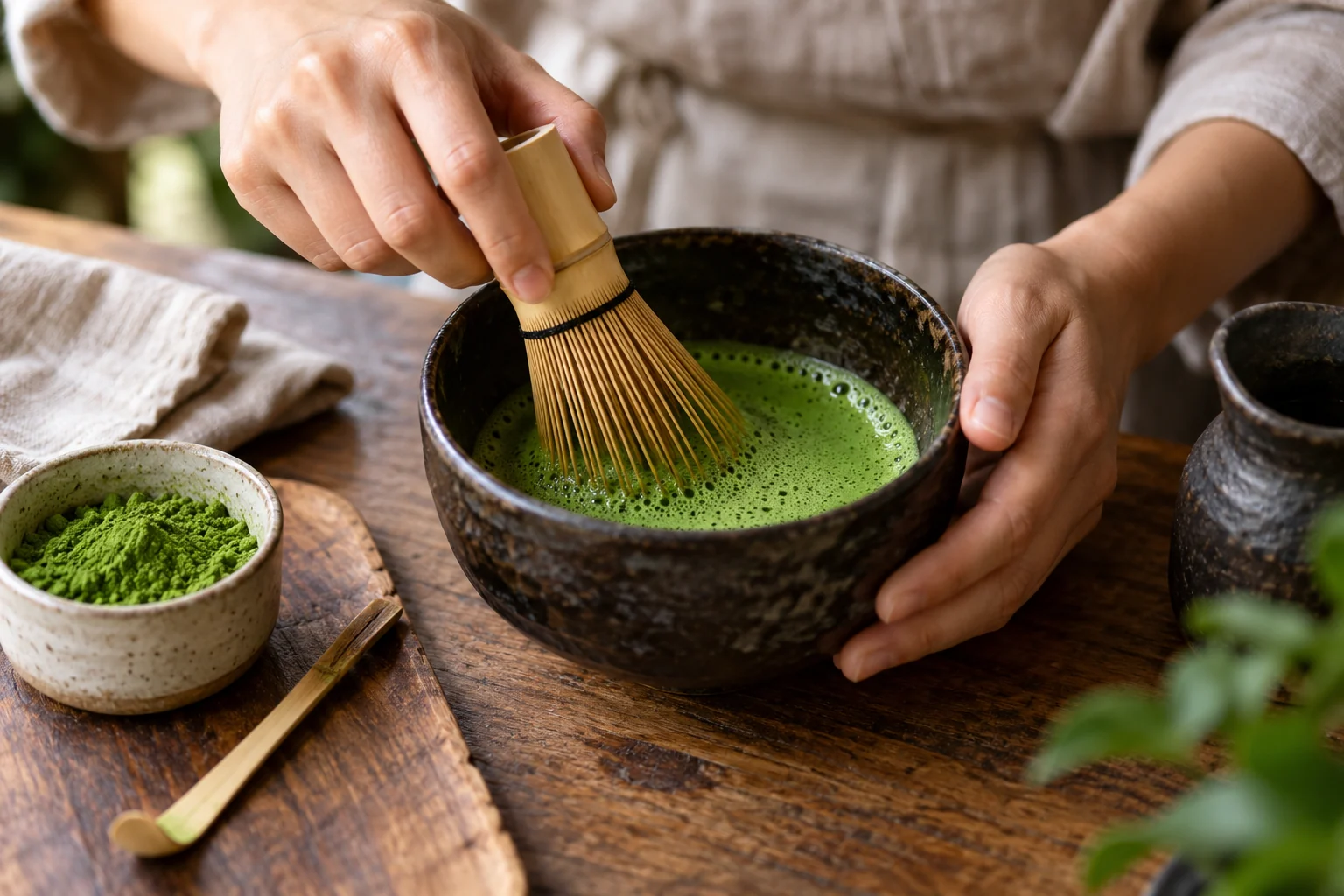
You can absolutely learn to whisk a good bowl of matcha in your kitchen. Our How to Make Matcha at Home: A Simple, Traditional-Inspired Method article covers that practical task.
Formal chado is broader.
A practiced tea procedure may include:
- selecting utensils for the season and occasion
- arranging the room and alcove
- preparing water and fire
- serving sweets or food depending on the gathering
- purifying and handling utensils in a prescribed way
- preparing matcha according to the school and procedure being practiced
- receiving and drinking tea as a guest with appropriate etiquette
- appreciating utensils, calligraphy, flowers and the setting
The exact procedures vary among schools and forms. A web article should not flatten them into one universal script.
The relationship between host and guest is central
Urasenke’s introductory materials emphasize the time shared between host and guest. The host prepares carefully for the occasion; the guest responds with attention and gratitude.
That makes the gathering participatory rather than theatrical.
The guest is not merely watching someone perform a set of beautiful gestures. The guest’s conduct, appreciation and awareness are part of the event.
This also helps explain why photography, talking, clothing and movement rules may vary at real tea experiences. Follow the host or venue rather than assuming every tea room works the same way.
Harmony, respect, purity and tranquility
Urasenke identifies four principles associated with the Way of Tea: harmony, respect, purity and tranquility.
These ideas are often written as wa, kei, sei, jaku.
For a beginner, they are more useful as a way to understand the spirit of practice than as decorative Japanese words to put on a graphic.
- Harmony can include attention to people, objects, season and setting.
- Respect includes how host and guest treat each other and the utensils being used.
- Purity is reflected in physical preparation and in the disciplined attention brought to the gathering.
- Tranquility is not simply silence; it develops through practice and awareness.
These principles gain meaning through actual chado practice.
What happens at a tea gathering?
There is no single universal event format, but official Japanese tourism guidance distinguishes between relatively informal chakai gatherings and more formal chaji.
A full chaji can be a substantial occasion and may include a meal, sweets, thick tea and thin tea depending on the tradition and procedure. Many visitor experiences are intentionally shorter and more accessible.
A beginner might encounter a sequence such as:
- entering the tea space according to the host’s guidance
- appreciating the room, scroll, flowers or utensils
- receiving a sweet
- watching the host prepare matcha
- receiving and drinking the tea according to guest etiquette
- appreciating the bowl or utensils when invited
- closing the exchange with thanks
Treat that as orientation, not a formal instruction manual.
Thin tea and thick tea are not interchangeable experiences
Matcha can be prepared in different forms.
Usucha, or thin tea, is the whisked matcha many beginners recognize. Koicha, or thick tea, uses more matcha and a different preparation and drinking context.
Urasenke’s own English-language study resources separate introductory procedures, usucha procedure and koicha procedure into advancing guidebooks. That is another reason a short article should not pretend to teach “the ceremony” as one fixed sequence.
For everyday matcha technique rather than formal chado training, return to How to Make Matcha at Home: A Simple, Traditional-Inspired Method.
The utensils are meaningful because of how they are used
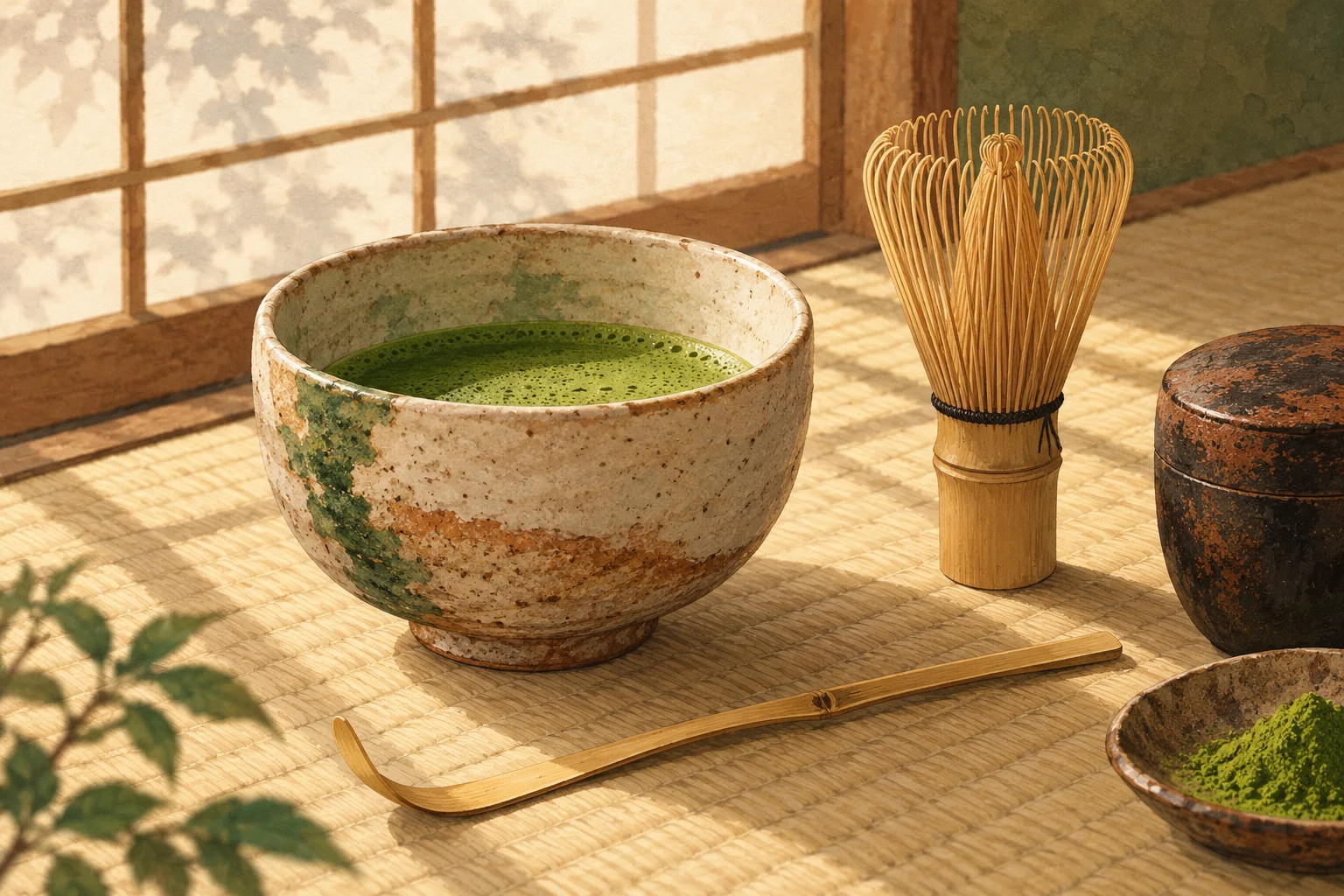
Beginners often encounter a few common objects:
- chawan — tea bowl
- chasen — bamboo whisk
- chashaku — tea scoop
- natsume or other tea container — depending on the preparation
- kettle and water vessel
- cleaning cloths and other procedure-specific implements
A shopping list is not the same thing as learning chado.