Learn how coffee extraction, strength, grind, ratio, time, temperature, flow and water chemistry work together so you can troubleshoot brews more intelligently.
Coffee brewing can sound more complicated than it needs to.
People talk about extraction percentages, total dissolved solids, particle distributions, turbulence and water chemistry as if you need a lab coat to make a good cup.
You do not.
The science becomes useful when it helps you answer one practical question:
Why did this cup taste the way it did, and what should I change next time?
At its core, brewing is controlled extraction. Water contacts roasted and ground coffee, dissolves some of its soluble material, and carries that material into the cup. Your recipe determines how concentrated that cup becomes and which parts of the coffee are emphasized.
The important part is that no brewing variable works alone.
Grind size changes surface area and flow. Ratio changes concentration and extraction conditions. Time affects how long water and coffee interact. Temperature affects extraction kinetics. Agitation changes how fresh water reaches particles. Water chemistry changes what the water is able to dissolve and how the cup is perceived.
That is why the best coffee troubleshooting is not about memorizing one perfect number. It is about understanding the system well enough to make one useful adjustment at a time.
The short answer
Coffee brewing has two different ideas that are often confused:
- strength: how concentrated the finished beverage is
- extraction: how much soluble material was removed from the dry coffee grounds
They are related, but they are not the same thing.
A cup can be strong and poorly extracted. It can also be relatively light in strength while still extracting the coffee efficiently.
If you remember only one concept from this article, remember this:
Do not use “strong” and “extracted” as synonyms.
That distinction makes ratio, grind, brew time and tasting much easier to understand.
What extraction actually means
Roasted coffee contains thousands of compounds, but only part of the roasted bean dissolves into brewing water under normal conditions.
As water contacts the grounds, soluble material moves into the liquid. Different compounds do not all dissolve at exactly the same rate or under exactly the same conditions.
The result is a moving extraction process rather than a switch that flips from “under” to “perfect” to “over.”
In brewing practice, extraction yield estimates the percentage of the original dry coffee mass that ended up dissolved in the beverage.
If 20 grams of dry coffee produced a beverage containing roughly 4 grams of dissolved coffee material, the extraction yield would be about 20%.
That does not mean 20% is automatically delicious. It means you have one measurement describing what happened.
Taste still matters.
What TDS tells you
TDS means total dissolved solids.
In coffee, TDS is commonly used as a measure of beverage strength: the percentage of the finished drink made up of dissolved coffee material.
A refractometer can estimate that concentration from a small sample.
This is where people sometimes get lost in numbers.
TDS is useful because two cups that look similar can have meaningfully different concentrations. But a TDS reading cannot tell you whether the coffee tastes floral, bitter, sweet, hollow or balanced.
It is a measurement, not a quality score.
UC Davis and Specialty Coffee Association research has repeatedly shown that brew strength and extraction are important drivers of sensory perception. That is exactly why they are useful diagnostic tools — and exactly why they should be paired with tasting instead of replacing it.
Strength and extraction can move independently
Imagine two brews made from the same coffee.
The first uses less water and produces a concentrated cup. The second uses more water and produces a lighter cup.
The first may have higher beverage strength simply because the coffee-to-water ratio is tighter.
That does not automatically mean it extracted a greater percentage of the coffee grounds.
Research on full-immersion brewing illustrates this distinction clearly. A 2021 Scientific Reports model and experiment found that beverage strength changes strongly with water-to-coffee ratio, while extraction yield at equilibrium can behave differently from strength.
For home brewing, the practical lesson is simple:
If a cup is too intense, you may have a strength problem, an extraction problem, or both. Taste before you decide which lever to pull.
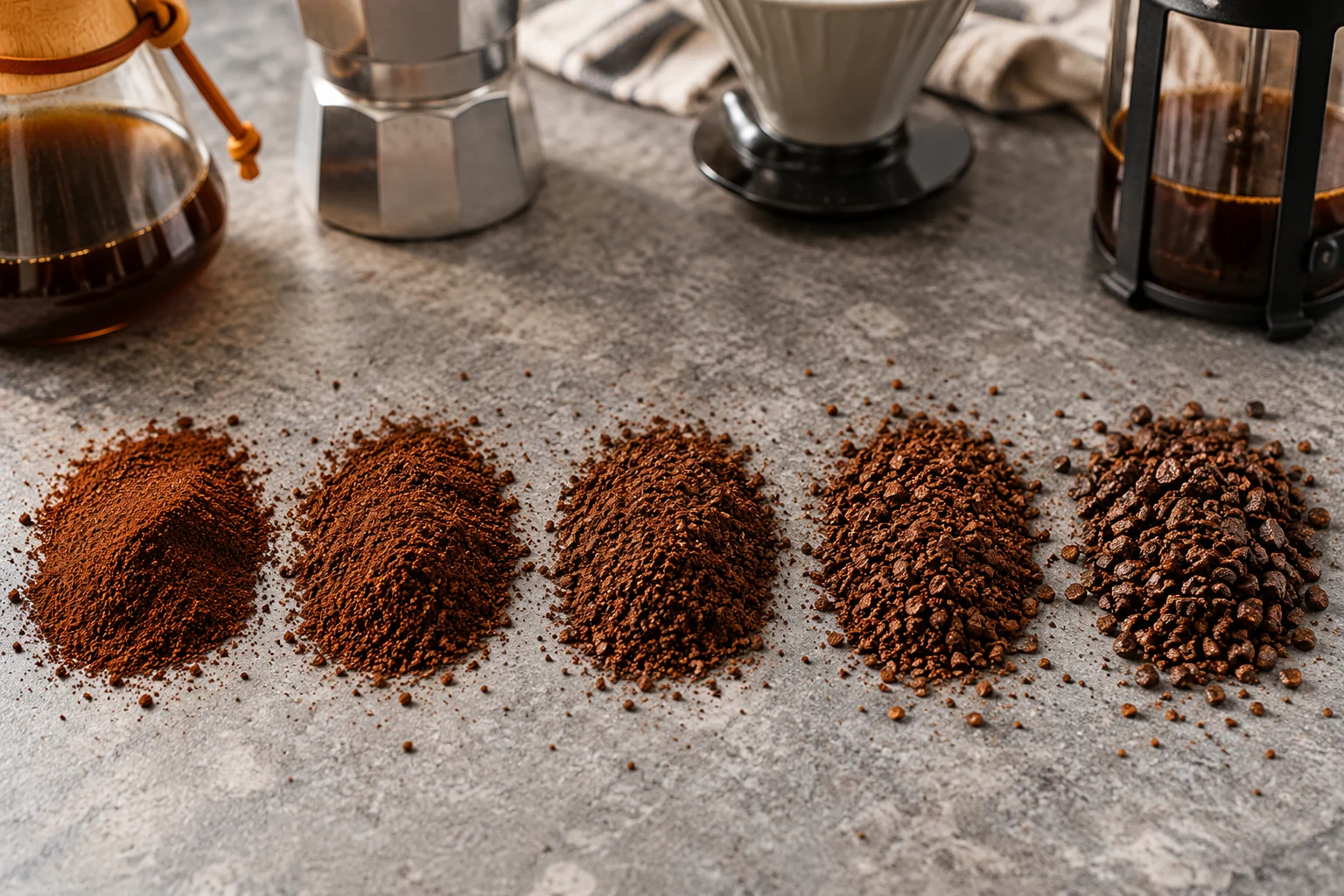
Grind size changes more than surface area
Grinding coffee smaller creates more exposed surface area, which can accelerate extraction.
But grind also changes how water moves through many brewers.
In a pour-over, finer grounds can increase resistance and slow drawdown. That gives water more contact time while also increasing available surface area.
In espresso, grind can dramatically change flow rate, pressure behavior and shot time.
In immersion brewing, flow resistance matters less during the steep itself, although particle size still affects extraction kinetics and filtration.
That means “finer extracts more” is directionally useful but incomplete.
A finer grind can simultaneously change:
- particle surface area
- flow resistance
- contact time
- channeling risk
- fines migration
- filtration behavior
Our grind-size guide turns those interactions into a practical dialing-in process.
Ratio is not just a recipe preference
Coffee-to-water ratio has an obvious effect on strength.
Use more coffee relative to water and the beverage will generally become more concentrated. Use more water relative to coffee and the beverage generally becomes less concentrated.
But ratio also changes the extraction environment.
In full-immersion brewing, research shows that strength is strongly linked to brew ratio while extraction yield does not necessarily move in the same way once the system approaches equilibrium.
In percolation brewing, changing ratio may also change bed depth, flow behavior and total water passing through the coffee.
So if you change ratio, do not assume you changed only “strength.”
For repeatable brewing, weigh both coffee and water. A scale is not mandatory for enjoying coffee, but it is one of the simplest ways to remove guesswork when you are troubleshooting.
Time matters because extraction is a process
Water needs time to interact with coffee.
But there is no universal brew time that applies to every method.
An espresso shot can extract rapidly because the coffee is finely ground and water moves through the puck under pressure.
A French press uses a much longer contact time because the grind is coarser and the coffee is immersed.
Cold brew stretches extraction across hours at much lower temperatures.
Even two pour-over recipes can use different total times because brewer geometry, grind, agitation and pouring pattern change flow.
Instead of treating brew time as a target by itself, use it as evidence.
If your pour-over suddenly takes a minute longer than usual with the same recipe, something changed — perhaps grind, fines, agitation, filter behavior or pouring technique.
That is useful information.
Temperature changes extraction kinetics, but it is not a magic flavor dial
Hotter water generally speeds extraction, but temperature does not determine flavor by itself.
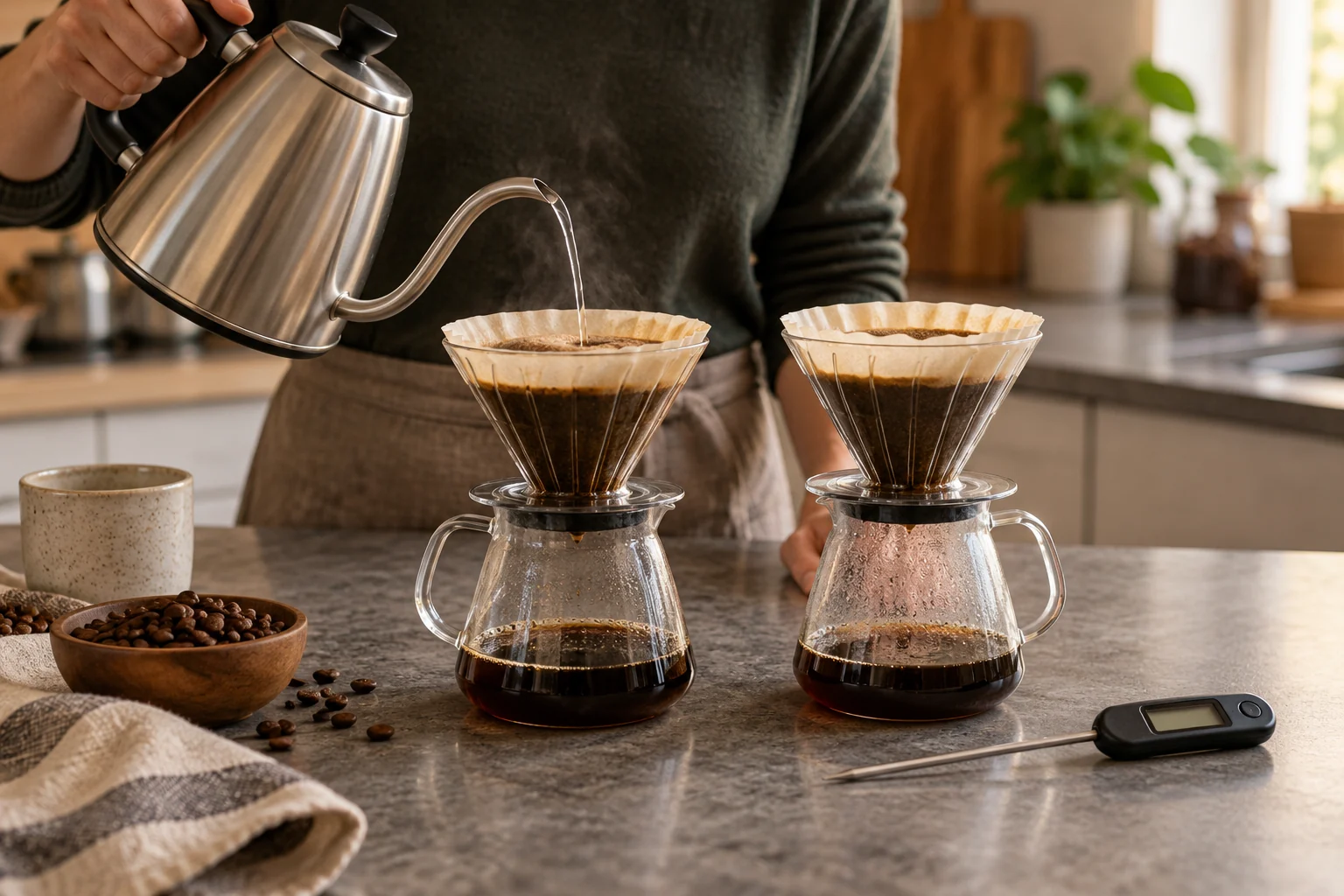
UC Davis/SCA research on drip brewing tested coffees brewed at 87°C, 90°C and 93°C while controlling brew strength and extraction. When those outcomes were held similar by adjusting other variables, the sensory differences attributable to brew temperature itself were much smaller than many coffee rules imply.
That does not mean temperature is irrelevant.
It means temperature belongs inside the full recipe.
Our coffee brewing temperature guide covers that research in detail and explains why roughly 90–96°C / 194–205°F is better treated as a useful starting region than a universal commandment.
Flow and agitation decide how water reaches the grounds
Extraction requires contact between water and coffee.
In an immersion brewer, grounds spend much of the brew surrounded by water. In a pour-over, fresh water continually enters the coffee bed and brewed liquid leaves it.
Agitation — stirring, swirling, pouring force or movement inside the brewer — changes that contact.
Some agitation can improve wetting and make extraction more even.
Too much or poorly controlled agitation can move fines, slow filters, disturb the bed or make a recipe less repeatable.
This is why copying someone else's pour pattern without understanding your grinder and brewer can produce very different results.
The goal is not “maximum agitation.” The goal is repeatable contact with as little unevenness as practical.
Channeling is uneven extraction in motion
Channeling happens when water finds easier paths through part of the coffee instead of moving evenly through the bed.
It is especially important in espresso, but uneven flow can matter in percolation brewing generally.
When some regions receive too much flow and others too little, the final beverage becomes a mixture of differently extracted zones.
That is one reason a cup can taste simultaneously sharp, hollow and drying.
You do not fix channeling by chasing one extraction number. You improve puck or bed preparation, distribution, grind consistency, pouring and flow.
Water is an ingredient, not just a carrier
Most brewed coffee is water, so water chemistry matters.
Mineral composition can change both extraction behavior and perceived flavor. Water that is extremely soft, extremely hard or strongly flavored can make a good coffee difficult to brew well.
You do not need to become a water chemist to make useful improvements.
Start with water that tastes clean on its own.
If your tap water smells strongly of chlorine or has a pronounced mineral character, try a suitable filter or compare it with another known drinking water before changing five coffee variables at once.
If the cup changes dramatically, you have identified water as part of the system.
Roast level changes how the coffee behaves
Roasting transforms the bean physically and chemically.
Darker roasting generally makes the coffee structure more porous and easier to extract, while dense light-roasted coffee may require a more aggressive recipe to reach the flavor you want.
That is why the same grind, temperature and brew time can behave differently across coffees.
Our roasting-level guide explains what roast labels can and cannot tell you.
Do not turn “light roast needs hotter water” into another rigid rule. It is a useful dialing-in tendency, not a guarantee.
Why the old brewing-control chart is useful — and limited
The coffee industry has long used brewing-control charts that plot beverage strength against extraction yield.
They are useful because they force you to separate concentration from extraction.
They are limited because a box on a chart cannot define deliciousness for every coffee, roast, brewer or person.
Modern UC Davis/SCA work intentionally brews across different strength and extraction conditions to study how those variables change sensory perception and liking.
The useful lesson is not “hit one exact target.”
It is measure consistently, taste carefully, and learn what different regions of strength and extraction do to the coffee you actually drink.
What underextracted coffee usually means
In everyday coffee language, “underextracted” often describes a cup where too little desirable soluble material has been pulled from the grounds or where extraction is very uneven.
Common sensory clues can include:
- sharp or aggressive acidity
- hollow sweetness
- thin finish
- salty or vegetal impressions
- a cup that seems strong in concentration but incomplete in flavor
But these are clues, not laboratory diagnoses.
A naturally bright coffee can be acidic without being underextracted.
Before changing everything, try one small move that tends to increase extraction: slightly finer grind, slightly longer contact, somewhat hotter water, or more even agitation — depending on the method.
What overextracted coffee usually means
“Overextracted” often describes a cup with excessive bitterness, dryness or astringency relative to the coffee's other qualities.
Again, the term is useful but not absolute.
Dark roast character can be bitter even at reasonable extraction. Water chemistry can create dryness. Uneven extraction can combine sour and bitter sensations in the same cup.
If your brew seems harsh and drying, try one move that tends to reduce extraction or improve evenness: a slightly coarser grind, shorter contact, gentler agitation or lower temperature where appropriate.
Then taste again.
A simple experiment that teaches more than a chart
Use one coffee, one brewer and one ratio.
Make Brew A with your normal grind.
Make Brew B slightly finer while keeping everything else as consistent as possible.
Taste them side by side as they cool.
Ask:
- Which tastes sweeter?
- Which tastes clearer?
- Which feels more drying?
- Did body change?
- Did brew time change?
- Did the finer grind improve the cup or simply make it more intense?
Then repeat another day with one different variable.
This is the same logic behind our Brew Better Coffee guide: change one thing at a time so the cup teaches you something.
Do you need a refractometer?
No.
A refractometer is useful for cafés, researchers and enthusiastic home brewers who want to measure TDS and estimate extraction yield.
But it does not replace sensory judgment.
For most home brewers, a grinder, a simple scale, consistent water, repeatable technique and written notes will improve coffee more than buying laboratory-style tools without a question you are trying to answer.
If you do use a refractometer, use it to compare brews and understand patterns — not to declare that a cup is objectively good because a number landed in a preferred zone.
A troubleshooting order that keeps science practical
When a brew goes wrong, work from the easiest variables toward the more complicated ones.
- Confirm the recipe. Did you use the intended coffee and water amounts?
- Check grind. Did the setting or grinder behavior change?
- Check brew time and flow. Was the drawdown much faster or slower than usual?
- Taste for concentration versus extraction. Is it simply too strong, or does it also taste incomplete or harsh?
- Check temperature and technique. Did kettle temperature, agitation or pouring change?
- Consider water and coffee age. Are you troubleshooting a different ingredient rather than the method?
- Change one variable. Do not rebuild the entire recipe at once.
Our coffee tasting guide can help you describe the result more precisely than “good” or “bad.”
Bottom line
Coffee brewing science is not a hunt for one perfect extraction percentage.
It is a way to understand cause and effect.
Strength tells you how concentrated the beverage is. Extraction tells you how much soluble material left the grounds. Grind, ratio, time, temperature, flow, agitation, water and roast all influence the path between dry coffee and finished cup.
The useful skill is not memorizing the chart.
It is learning which variable to change next — and changing only enough to learn from the result.