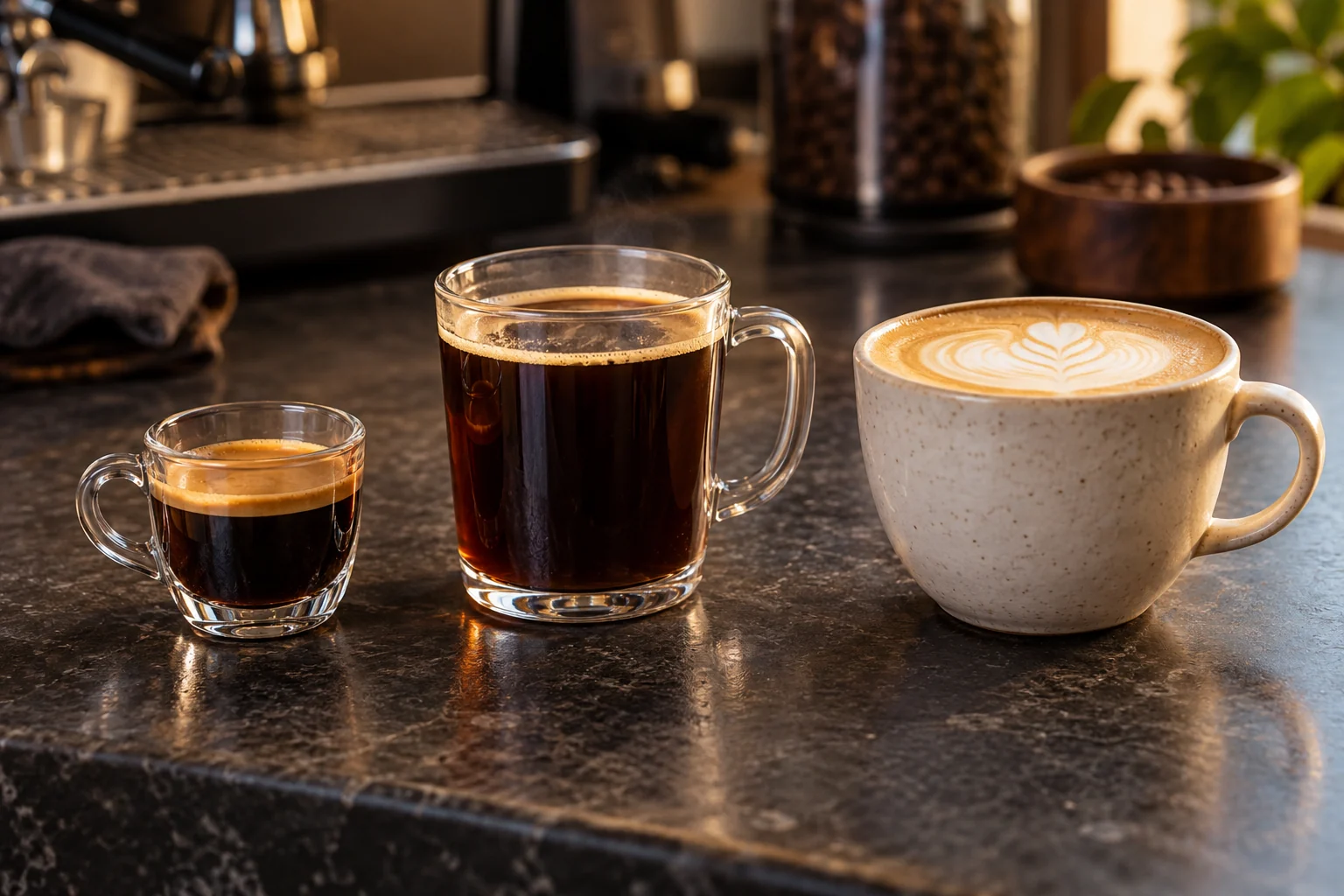
Espresso, Americano, and latte can all begin with espresso, but they are very different drinks. Espresso is the concentrated coffee base. An Americano dilutes espresso with water. A latte combines espresso with a much larger amount of steamed milk and a layer of microfoam.
The biggest differences are concentration, texture, milk, serving size, and how the espresso’s flavor is perceived.
Caffeine is not as simple as “espresso is strongest.” The final caffeine depends largely on how many espresso shots are used, not just the finished drink size.
Quick comparison
| Drink | Core ingredients | Typical texture | Flavor impression | Main variable |
|---|---|---|---|---|
| Espresso | espresso only | concentrated, syrupy to fluid | intense, aromatic | shot recipe/extraction |
| Americano | espresso + hot water | lighter, coffee-like | espresso flavor spread through a larger drink | shot count + dilution |
| Latte | espresso + steamed milk + microfoam | creamy, smooth | milk softens roast, bitterness and acidity | shot count + milk ratio/texture |
Cafe recipes vary. The table describes the drink families, not a legally fixed recipe for every shop.
What is espresso?
Espresso is coffee brewed by forcing hot water through finely ground coffee under pressure.
A historical Specialty Coffee Association of America definition described a single espresso as roughly 25–35 ml made from 7–9 g of coffee, with water around 195–205°F and a brew time around 20–30 seconds. Modern specialty cafes frequently use larger coffee doses, different ratios, and different shot volumes, and the SCA itself has documented how much contemporary espresso practice has evolved.
That is important because espresso is a method and a concentrated beverage, not one universally fixed recipe.
A cafe may use a double shot as its default base. Another may use a different dose and yield. If you are comparing caffeine or strength, ask about the actual shot count and recipe.
What does espresso taste like?
Espresso compresses a lot of flavor into a small volume.
Depending on the coffee and extraction, you may notice:
- concentrated sweetness
- strong acidity
- bitterness
- chocolate or caramel
- fruit or florals
- roast character
- a lingering finish
Crema can contribute aroma and texture, but a thick crema layer by itself does not prove that the espresso tastes good.
What is an Americano?
An Americano is espresso diluted with hot water.
The drink preserves the espresso base while reducing its concentration and increasing its volume.
That can make the coffee easier to sip over a longer period and can reveal flavors that feel compressed in a straight shot.
The basic formula is:
espresso + hot water
But cafes vary in:
- number of espresso shots
- water volume
- whether espresso or water enters the cup first
- final serving size
An Americano is not the same as drip coffee. The brewing method that created the coffee base is still espresso.
What does an Americano taste like?
Compared with straight espresso, an Americano usually feels:
- less concentrated
- lighter in body
- less intense per sip
- easier to drink in a larger volume
It can still carry the espresso’s acidity, bitterness, roast, fruit, or chocolate characteristics.
Adding water does not remove those compounds. It dilutes them.
What is a latte?
A latte combines espresso with steamed milk and a relatively thin layer of microfoam.
The basic formula is:
espresso + steamed milk + microfoam
Milk changes the drink much more dramatically than water does.
It adds:
- sweetness from lactose or the flavor profile of a plant-based alternative
- creamy texture
- more volume
- lower perceived coffee intensity
A latte can be served in many sizes, so the espresso-to-milk ratio varies significantly among cafes.
Latte vs cappuccino vs flat white
These drinks overlap more than internet diagrams often suggest.
Very broadly:
- latte: more milk, gentle microfoam, larger milk-to-espresso ratio
- cappuccino: typically smaller, with a stronger balance of espresso, milk, and foam
- flat white: generally smaller than a latte, with integrated fine microfoam and a relatively stronger coffee-to-milk impression
Real cafe recipes vary by country, shop, cup size, and house style.
Avoid treating one infographic ratio as a global law.
Which drink is strongest?
“Strong” can mean several different things.
Strongest flavor concentration
Straight espresso.
It contains the same shot’s dissolved coffee in the smallest volume.
Strongest coffee flavor in a large drink
Often an Americano, because water dilutes the espresso without adding milk flavor.
Mildest coffee impression
Usually a latte, because milk changes both concentration and sensory balance.
Most caffeine
Whichever drink contains the most espresso shots — assuming the same espresso recipe.
A 12-ounce latte with two shots can contain more caffeine than a tiny single espresso even though it tastes much milder.
Does espresso have more caffeine than coffee?
Per fluid ounce, espresso is highly concentrated and usually contains more caffeine than ordinary brewed coffee.
Per serving, the answer can reverse because a standard brewed coffee serving is much larger.
The FDA notes that caffeine content varies widely among coffee beverages and that serving size matters. It also cites 400 mg per day for most adults as an amount not generally associated with negative effects, while emphasizing that individual sensitivity, medications, medical conditions, and body weight can change what is appropriate.
Do not use taste intensity as a caffeine meter.
Americano caffeine vs espresso
If one Americano contains one espresso shot, it has approximately the caffeine of that shot. Water does not add caffeine.
If the cafe uses two or three shots, the caffeine rises accordingly.
This makes shot count more useful than cup size when comparing Americanos.