Choose a coffee grinder by brew method, adjustment range, consistency, retention, workflow and maintenance instead of relying on generic best-of rankings.
The best coffee grinder is not one universal machine. It is the grinder that can produce the particle-size range your brewing method needs, adjust predictably, retain little coffee, fit your workflow, and stay easy enough to clean that you will actually maintain it.
For most people buying a serious home grinder, a burr grinder is the better starting point than a blade grinder because the burr spacing gives you repeatable control over grind size.
But “burr grinder” is only the beginning of the decision.
Start with the coffee you actually make
Before comparing burr diameter, motor wattage, or screen graphics, identify your main brewing method.
Mostly drip, pour-over, AeroPress, or French press
Prioritize:
- useful adjustment through medium and coarse settings
- good grind consistency at filter sizes
- low retention
- simple dosing
- easy cleaning
You usually do not need ultra-fine espresso adjustment.
Mostly espresso
Prioritize:
- very small adjustment steps or stepless control
- repeatability when dialing in
- low retention
- a workflow that fits your portafilter or dosing cup
- stable burr alignment
Espresso is especially sensitive to particle-size distribution because fines and grind setting affect flow through the puck.
Research on espresso extraction has shown that fines can reduce coffee-bed permeability and significantly change flow time. That is one reason a single number labeled “fine” cannot fully describe how a grinder will behave.
Espresso and filter from one grinder
Look for a grinder with enough usable range to move between both methods without making adjustment frustrating.
A broad settings count by itself is not proof. What matters is whether the grinder gives you enough resolution where you need it and whether you can return to previous settings reliably.
Cold brew or French press
You need a grinder that can produce coarse grounds without an excessive amount of fines.
Our cold brew guide explains why the grind is only one variable, while Find the Right Grind Size covers method-by-method adjustment.
Why burr grinders are usually the better choice
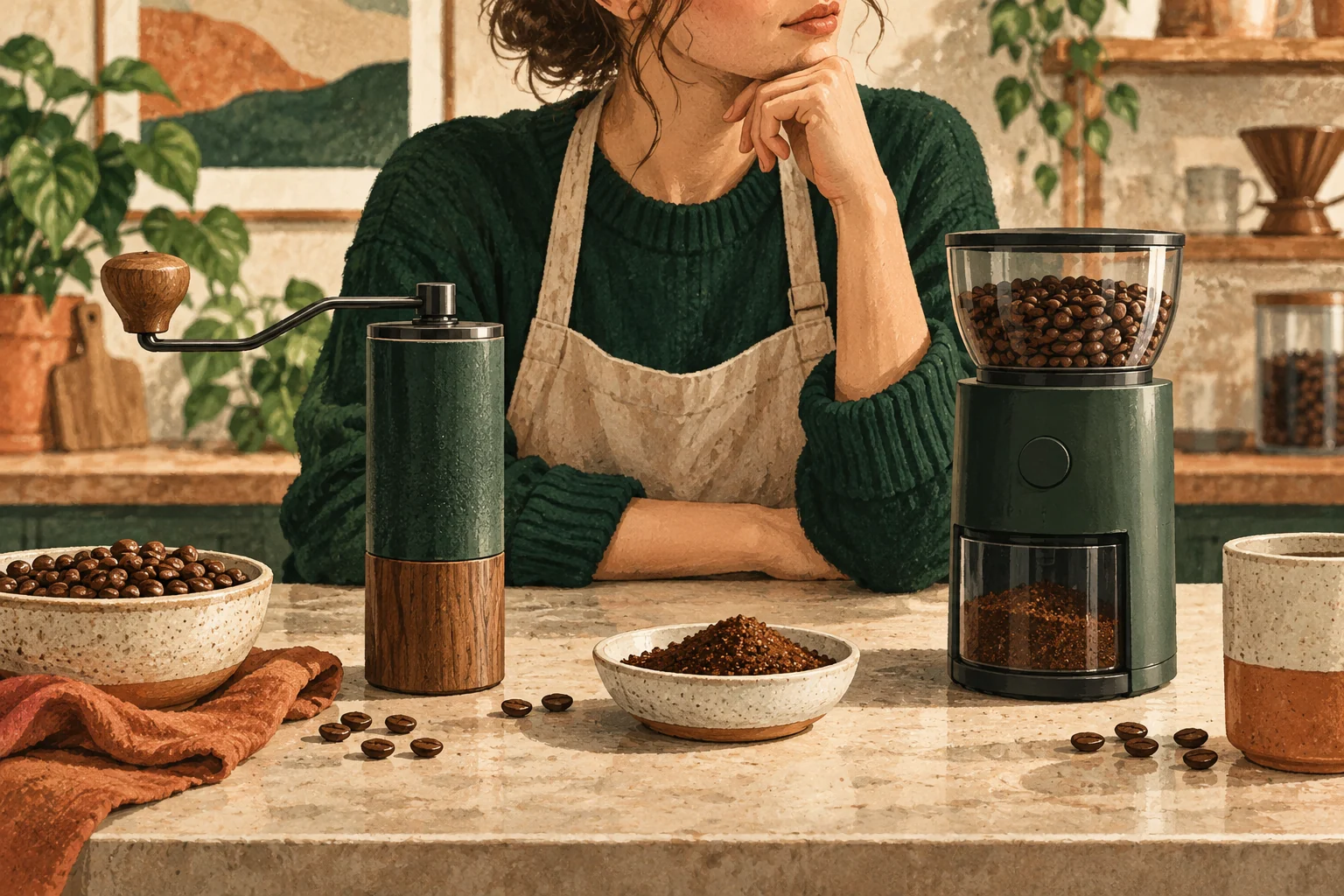
A burr grinder crushes or cuts coffee between two abrasive surfaces separated by a controlled distance.
Changing that distance changes the dominant particle size.
A blade grinder repeatedly chops coffee with a spinning blade. The longer it runs, the smaller the average pieces become, but the process gives you much less direct control over particle size and can create a wide mix of large pieces and fines.
That does not mean every burr grinder is excellent.
Burr geometry, alignment, motor behavior, feed rate, static, retention, and construction all influence the grounds that reach your brewer.
But burr adjustment gives you a repeatable control mechanism that blade grinding lacks.
Conical vs. flat burrs
You will see strong opinions about conical and flat burrs.
Do not treat the burr shape alone as a quality score.
Both designs can make excellent coffee.
The finished particle-size distribution depends on the full grinder system, including:
- burr geometry
- burr diameter
- alignment
- rotation speed
- motor and gearbox
- bean feed
- roast level
- static and clumping
Choose the grinder, not a slogan about its burr type.
Grind consistency is more complicated than “all particles the same size”
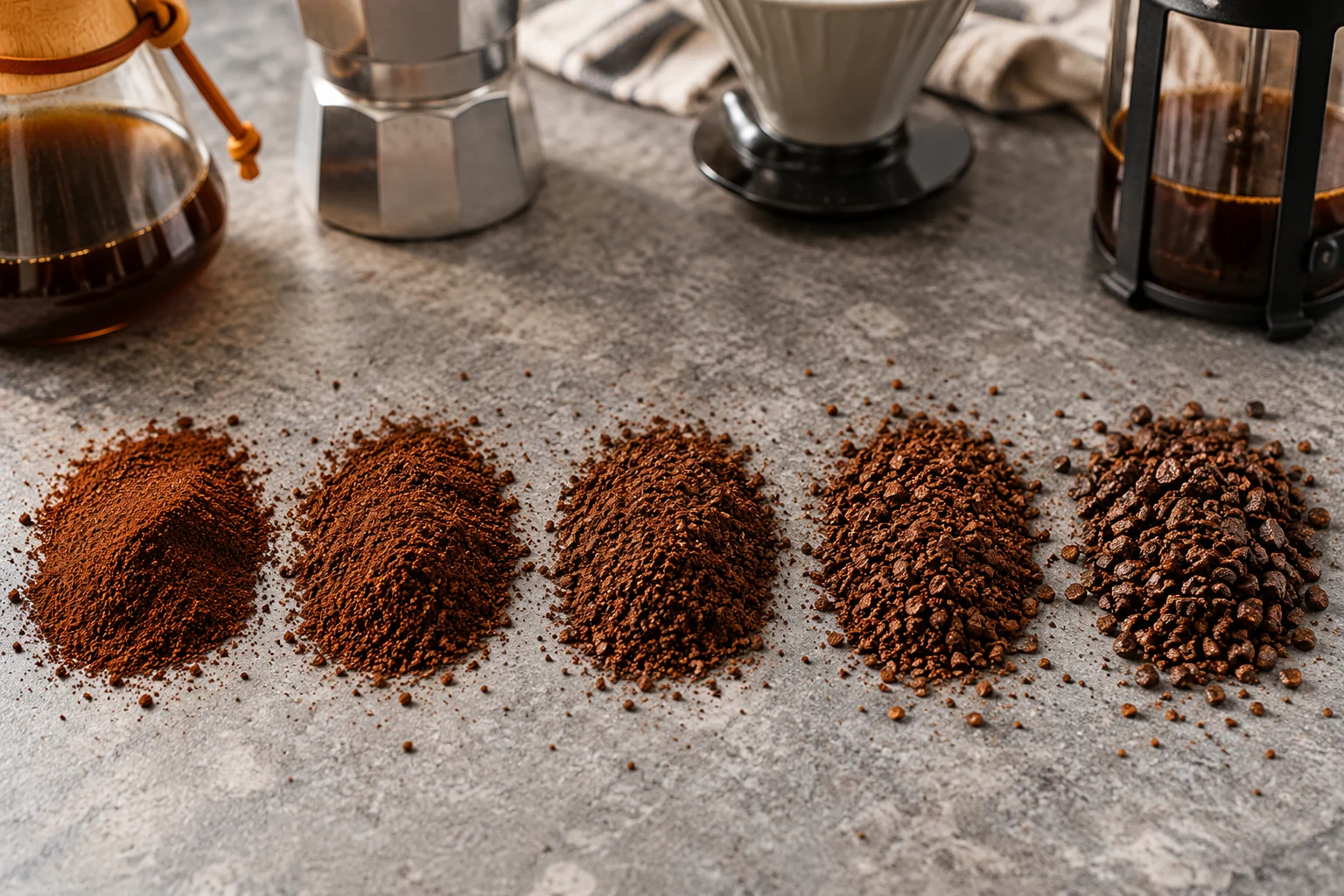
Real ground coffee contains a distribution of particle sizes.
Research on capsule and espresso extraction describes coffee grounds as commonly having a bimodal particle-size distribution: a main population of larger particles plus a separate population of very fine particles.
Those fines can behave differently from the larger particles during brewing.
For espresso, higher fines fractions can reduce permeability and slow flow through the coffee bed.
For filter brewing, excessive fines can contribute to slow drawdown or muddy texture depending on the brewer and filter.
So when reviews describe a grinder as “consistent,” what matters is not literal uniformity. It is whether the distribution is appropriate and repeatable for the brew method.
Why adjustment resolution matters
A grinder can have 60 settings and still be awkward for espresso if each step changes the grind too much.
Another grinder can have fewer labeled positions but place those adjustments where your brew methods need them.
For espresso, smaller steps are especially useful because a small grind change can materially change shot time.
For French press, cold brew, or batch drip, you usually do not need the same micro-adjustment resolution.
Ask:
- Are the settings stepped or stepless?
- Can I return to a previous setting accurately?
- Is the adjustment range usable for my methods?
- Does changing settings require the grinder to be running?
- Is internal burr recalibration available if the outer range no longer suits my coffee?
Stepped vs. stepless adjustment
Stepped
The dial clicks into defined settings.
Advantages:
- easy to record recipes
- easy to return to a previous setting
- straightforward for shared households
Tradeoff:
- one step may sometimes be wider than you want for espresso
Stepless
The adjustment moves continuously.
Advantages:
- very fine control
- useful for espresso dialing-in
Tradeoffs:
- harder to return to an exact previous point unless the dial has excellent markings
- switching between brew methods can be less convenient
Neither system is inherently better. Match it to your workflow.
What is retention and why should you care?
Retention is coffee that remains inside the grinder instead of exiting into your dosing cup, filter, or portafilter.
Some retention is normal in many designs.
High retention matters because:
- your dose out may differ from your dose in
- old grounds can mix into the next brew
- changing coffees may require purging
- single-dose workflows become less predictable
If you switch between beans frequently, retention may matter more to you than hopper capacity.
Hopper grinder vs. single-dose grinder
Hopper workflow
A hopper holds multiple doses of beans.
Good for:
- speed
- repeated daily use of the same coffee
- households making several drinks
Tradeoffs:
- beans may sit exposed to more air/light depending on hopper design
- switching coffees can be inconvenient
- retained grounds may mix between settings or beans
Single dosing
You weigh one dose, grind it, and leave the hopper mostly empty.
Good for:
- changing coffees often
- recipe control
- weighing input/output
- reducing stale coffee in the hopper
Tradeoffs:
- requires weighing each dose
- some grinders marketed for single dosing still retain coffee internally
Choose the workflow you prefer rather than assuming single dosing is automatically more “professional.”
Static and clumping
Grinding generates electrostatic charge.
That can make grounds cling to the chute, counter, dosing cup, or each other.
A 2024 study found that adding very small amounts of water to whole beans before grinding greatly reduced charge and clumping. In the tested espresso conditions, this also changed the particle distribution reaching the puck and increased beverage concentration for darker roasts.
This practice is often called the Ross Droplet Technique, or RDT.
If you try it, use only a tiny amount of water and confirm the grinder manufacturer does not prohibit the practice. Do not pour water into the burr chamber.
Burr size: useful specification, weak shortcut
Larger burrs can support higher throughput and different geometries, but burr diameter alone does not tell you how the coffee will taste.
Alignment and burr design matter.
A well-designed smaller-burr grinder can outperform a poorly aligned larger-burr grinder for your use case.
Do not buy by millimeters alone.
Motor speed and heat
Grinding creates heat, but the common claim that any high-speed grinder “burns the coffee” is too simplistic.
Research has shown that bean temperature itself can change the resulting particle-size distribution during grinding. Grinder design, burr geometry, motor load, and operating pattern all interact.
For normal home doses, focus more on repeatability, burr quality, and workflow than on a single RPM number without context.
Manual vs. electric grinders
Manual
Advantages:
- often excellent burr quality for the price
- compact
- quiet
- no motor to fail
- useful for travel
Tradeoffs:
- physical effort
- slower for multiple doses
- very light roasts or fine espresso settings can require substantial force
Electric
Advantages:
- faster
- easier for repeated drinks
- convenient for espresso and larger batches
Tradeoffs:
- larger footprint
- more noise
- more mechanical/electronic parts
- price can climb quickly
A good hand grinder can be a better value than a cheap electric grinder if you make one or two coffees at a time.
What grinder features actually matter?
High priority
- useful range for your brew methods
- repeatable adjustment
- suitable consistency
- low/moderate retention
- access for cleaning
- available replacement parts
- stable burr carrier/alignment
- dosing workflow you enjoy
Nice to have
- timed dosing
- weight-based dosing
- removable dosing cup
- portafilter cradle
- anti-static system
- programmable presets
Often overemphasized
- huge number of settings without knowing their spacing
- decorative display
- maximum hopper size if you single-dose
- burr diameter as a standalone quality score
How much should you spend?
Spend enough to remove the grinder as the obvious weak point in your brewing setup, then stop when additional features no longer solve a problem you actually have.
For a beginner making filter coffee, a competent entry-level burr grinder can be transformative compared with pre-ground coffee or a blade grinder.
For espresso, the grinder usually deserves a larger share of the budget because the fine adjustment demands are much higher.
If your espresso machine is capable but you cannot control shot time without large jumps, the grinder may be the limiting factor.
Grinder for espresso
For espresso, prioritize:
- fine adjustment resolution
- repeatability
- low retention
- stable output
- convenient dosing into a portafilter or cup
The grinder should let you make small enough changes that you can correct a shot without jumping from too fast to too slow in one click.
Our grind-size guide explains how to use taste and flow instead of treating a setting number as universal.
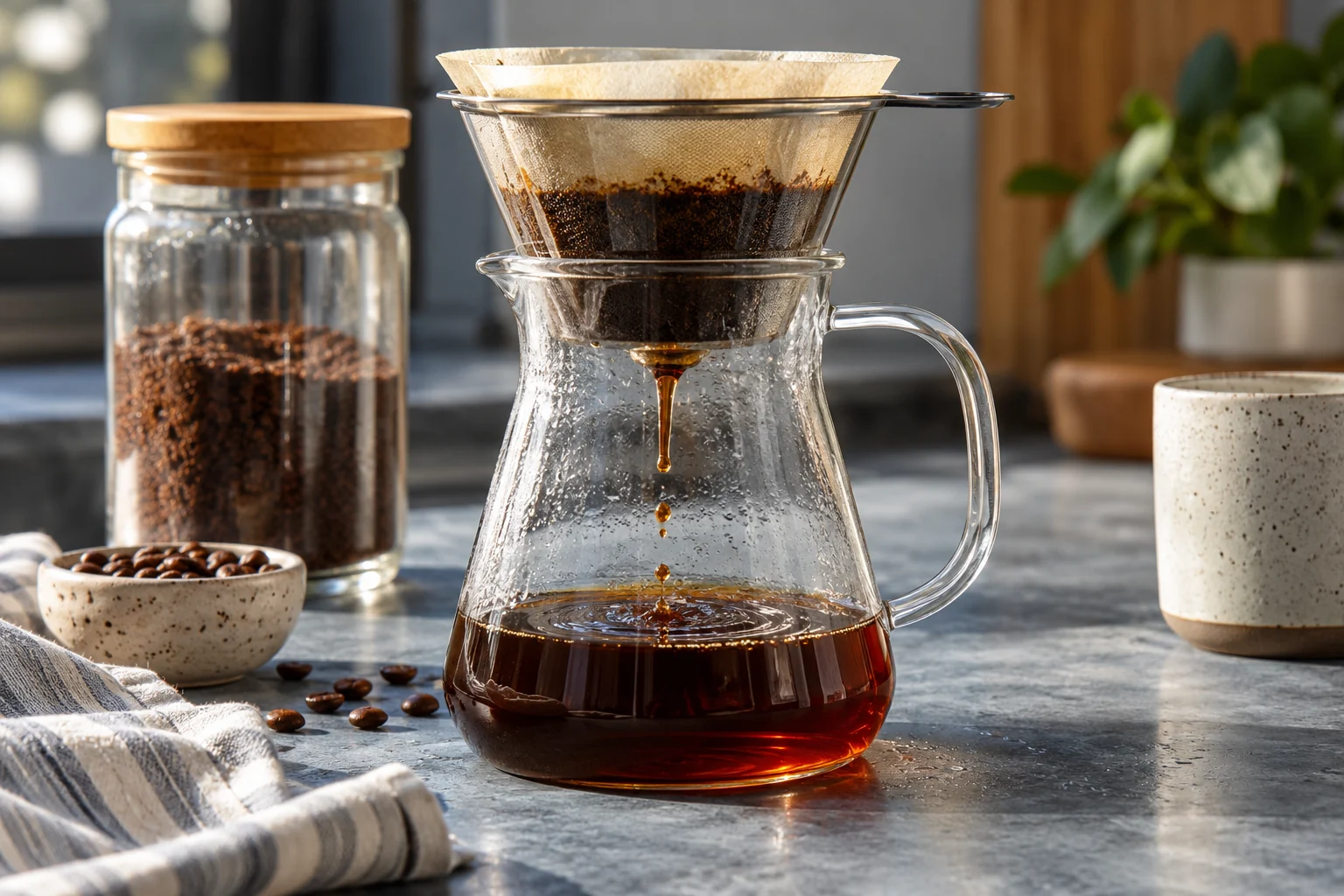
Grinder for pour-over
For pour-over, prioritize:
- clean filter-range particle distribution
- repeatability
- moderate/low fines
- low retention
A grinder that produces too many fines can slow drawdown and complicate recipe changes.
Our Coffee with April W60 feature is a useful example of how grind setting interacts with a real pour-over recipe rather than existing as an isolated number.
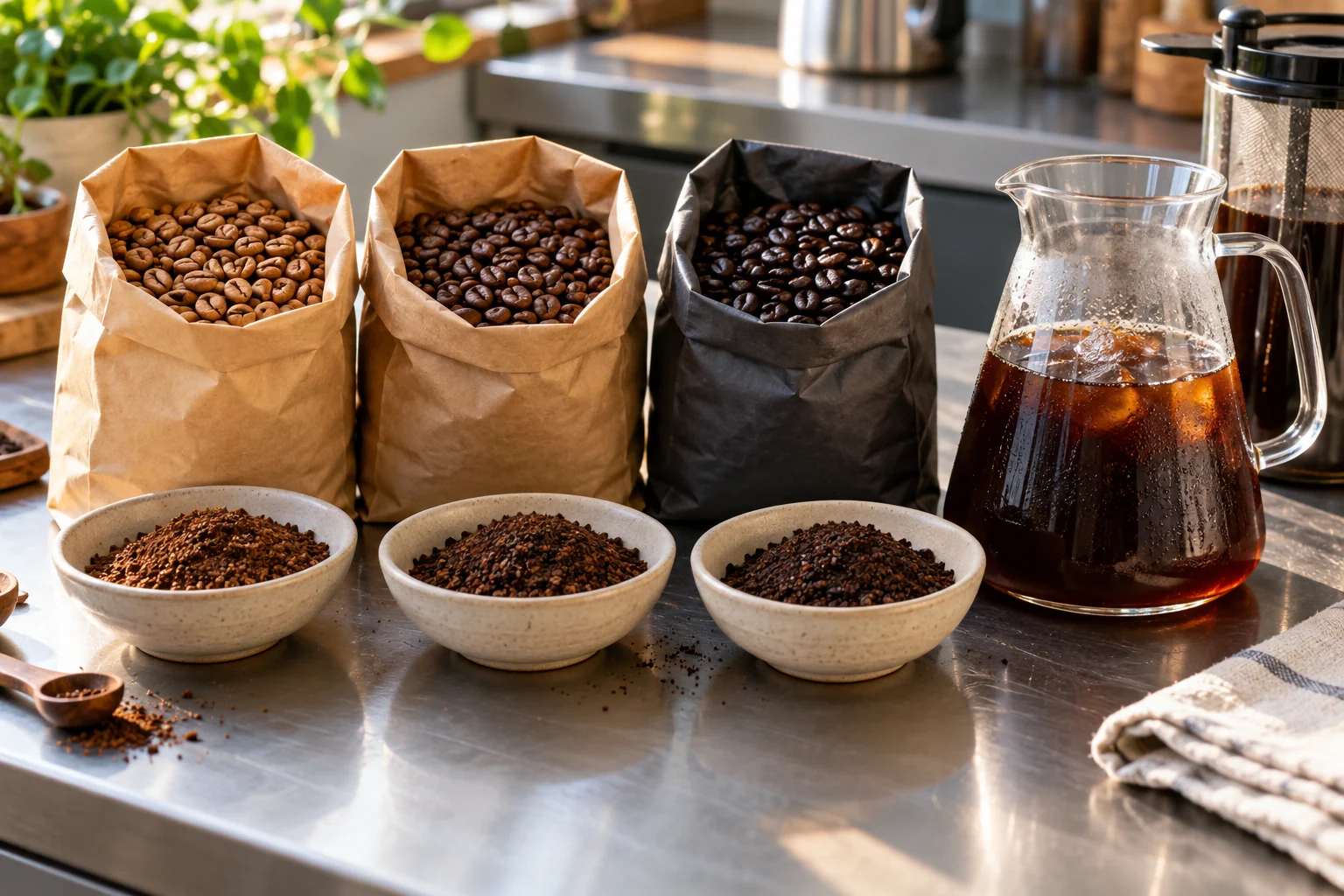
Grinder for cold brew
You do not need an expensive espresso grinder for cold brew.
You need:
- reliable coarse settings
- manageable fines
- enough capacity for the batch size you make
- easy cleaning
See Cold Brew Coffee Made Simple for the full method.
Grinder for French press
French press often starts coarse, but “coarse” should not become a rule that prevents adjustment.
If the coffee is weak and hollow, try somewhat finer before simply extending the steep forever.
If the cup is excessively silty, look at both grind distribution and filter design.
Cleaning and maintenance
Coffee oils and fine particles accumulate around burrs and chutes.
A grinder that is difficult to clean may gradually become less pleasant to use.
Before buying, check:
- whether the upper burr removes without losing calibration
- how often the manufacturer recommends cleaning
- whether replacement burrs are sold
- whether the chute is accessible
- whether the grinder has long-term parts/support
Do not wash burrs with water unless the manufacturer explicitly says they are washable.
How to compare grinders without fake “best” rankings
Use a short scorecard:
| Question | Why it matters |
|---|
| Does it cover my brew methods? | Avoid paying for range you cannot use or missing needed settings. |
| Are adjustments fine enough? | Critical for espresso; useful for recipe control. |
| Can I return to settings reliably? | Matters when switching methods or coffees. |
| How much coffee is retained? | Affects dosing and freshness. |
| How easy is cleaning? | Determines long-term consistency and use. |
| Are parts and support available? | Grinders are mechanical tools that wear. |
| Does the workflow fit me? | The best grinder is useless if you hate using it. |
This is more durable than a numbered “Top 10” list that becomes stale as prices and models change.
Check support before buying
Before choosing a grinder, check the manufacturer's current manual, replacement parts, cleaning instructions, and regional availability. A supported model can be easier to maintain over time.
Breville's Smart Grinder Pro (BCG820) support resources cover setup, cleaning, parts, and troubleshooting. Compare its adjustment range and workflow with your preferred brew methods, and verify current specifications and availability directly with the manufacturer before buying.
Bottom line
Choose a grinder by brew method, adjustment quality, particle distribution, retention, maintenance, and workflow — not by a generic ranking.
For filter coffee, prioritize reliable medium/coarse performance and low fines. For espresso, prioritize fine adjustment resolution and repeatability. For mixed use, make sure moving between methods is practical.
A grinder is a control tool. The right one makes it easier to change one variable at a time and understand what happened in the cup.