“Sustainable coffee” is not one farming method, one certification, or one type of bean. A more sustainable coffee system tries to protect long-term farm productivity while reducing damage to forests, soil, water and biodiversity and improving resilience for the people who grow coffee.
That means the useful question is not “Is this coffee sustainable?” as though sustainability were a yes-or-no label. It is: what practices, standards and outcomes are actually behind the claim?
What sustainable coffee farming can include
Depending on climate, farm size, elevation and local ecology, better coffee production may involve:
- maintaining or restoring shade trees
- protecting existing forest and waterways
- reducing soil erosion
- using mulch, cover crops and organic matter to improve soil condition
- applying fertilizers and crop-protection products more precisely
- conserving water during cultivation and processing
- choosing varieties that fit local disease and climate pressures
- improving farm-level traceability
- protecting workers and communities
- diversifying farm income where practical
No single practice solves everything. A farm can do well in one area and still have serious gaps in another.
Shade-grown coffee can support habitat, but “shade-grown” needs context
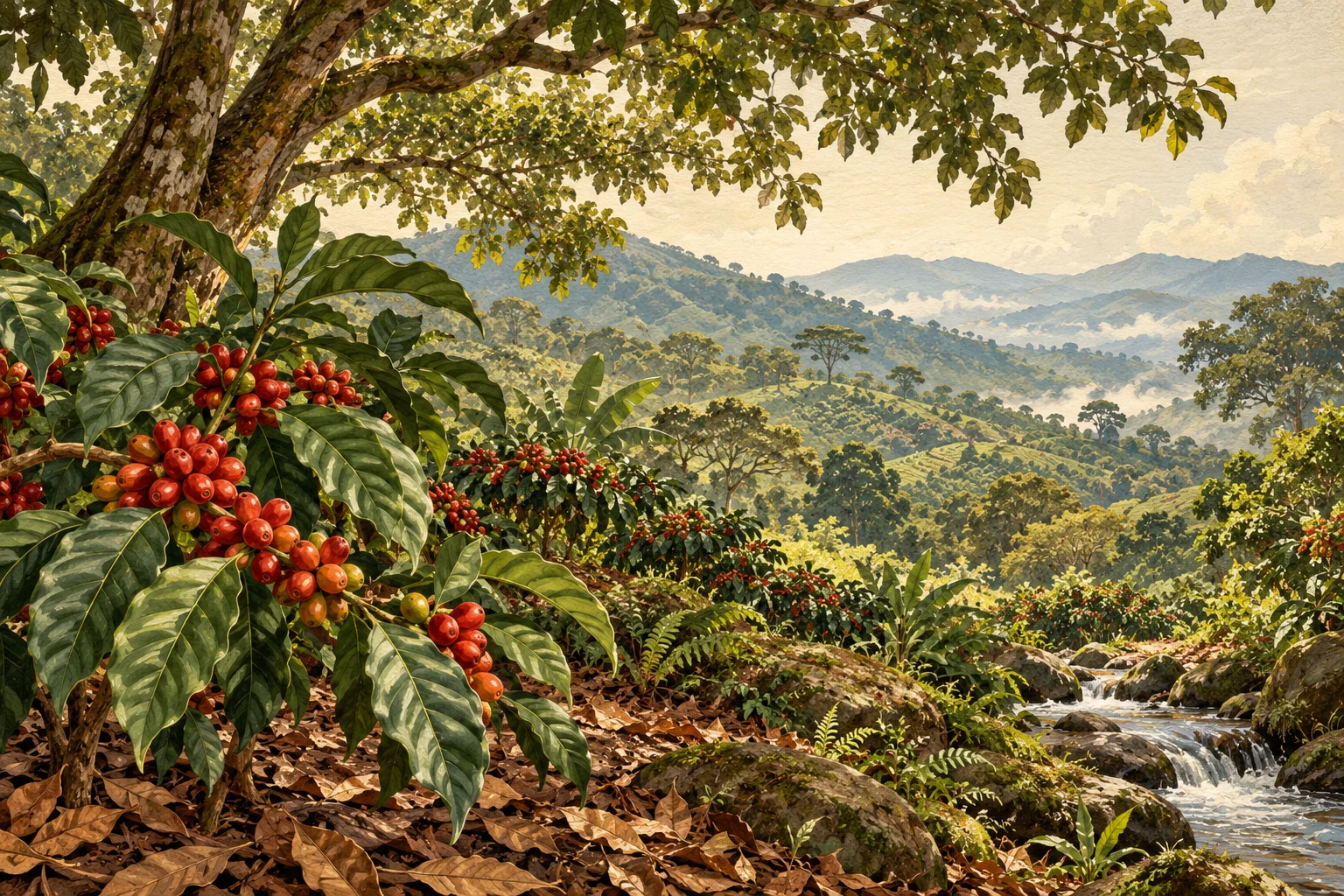
Coffee was traditionally grown within more complex tree cover in many regions. Agroforestry systems combine coffee with shade trees and other useful species rather than treating the farm as a single-layer crop.
The FAO describes shade-grown coffee as an agroforestry system that can combine coffee with fruit, timber and leguminous trees in multiple vegetation layers. Those trees can contribute to soil protection, microclimate regulation and diversified farm resources.
But the phrase shade-grown by itself does not tell you how much shade exists, what tree species are present, whether native habitat is protected or whether the farm avoids deforestation.
The Smithsonian Migratory Bird Center’s Bird Friendly program is useful because it turns vague shade claims into measurable criteria. Bird Friendly farms must meet organic requirements and use agroforestry or forest-conservation standards designed to maintain habitat and tree diversity.
That does not mean every coffee without the Bird Friendly seal is environmentally poor. It means a third-party standard can tell a buyer more than an unsupported marketing phrase.
Healthy soil is part of climate resilience
Coffee plants depend on soil that can hold water, cycle nutrients and support roots through wet and dry periods.
Practical soil-focused measures can include:
- mulching
- compost or other organic matter
- ground cover between rows
- erosion-control structures on slopes
- keeping soil covered instead of bare
- managing fertilizer according to actual crop and soil needs
FAO examples of climate-adaptation work in coffee combine agroforestry with mulching, trenches and composting to improve soil and water conservation during dry spells.
The exact recipe should vary by farm. “Regenerative,” “organic” or “natural” language should not replace agronomic evidence.
Water management matters both on the farm and during processing
Coffee uses water in more than one place.
Farm-level priorities can include protecting springs and streams, maintaining vegetated buffer areas, improving irrigation efficiency where irrigation is used, and reducing runoff and erosion.
Post-harvest processing can also create water and wastewater challenges, especially in wet-processing systems.
A credible sustainability story therefore should look beyond the trees themselves and ask what happens during cherry processing, washing, fermentation, drying and waste handling.
Biodiversity is more than putting a few trees between coffee rows
A coffee farm can contain meaningful habitat, especially when it retains diverse tree cover and connects with surrounding forest.
The Smithsonian’s long-running Bird Friendly work focuses on canopy structure, foliage cover and tree diversity because habitat quality depends on more than the presence of a generic shade tree.
That distinction matters for consumers. A package saying “shade coffee” may sound ecological, but a verified biodiversity standard provides more information about how the landscape is actually managed.
Climate resilience also depends on the coffee plants themselves
Farm management is only part of the equation.
World Coffee Research is developing and evaluating coffee varieties for traits such as quality, yield, disease resistance and climate resilience. Variety choice matters because a plant that performs well in one environment may struggle in another.
For farmers, resilience can mean balancing several goals:
- cup quality
- productivity
- disease pressure
- heat or drought stress
- local rainfall patterns
- farm elevation
- input requirements
That is one reason sustainability discussions should not automatically treat a famous variety as the best agricultural choice everywhere.
Our Arabica vs. Robusta Coffee: What’s the Difference? article makes the same point at the species level: flavor reputation and farm resilience are separate questions.
Certification can help, but certifications do different jobs
Coffee buyers see labels such as organic, Rainforest Alliance and Bird Friendly, sometimes alongside fair-trade claims.
These should not be treated as interchangeable.
Different programs may focus on different combinations of:
- chemical use
- forest protection
- biodiversity
- traceability
- labor practices
- producer economics
- auditing
- climate adaptation