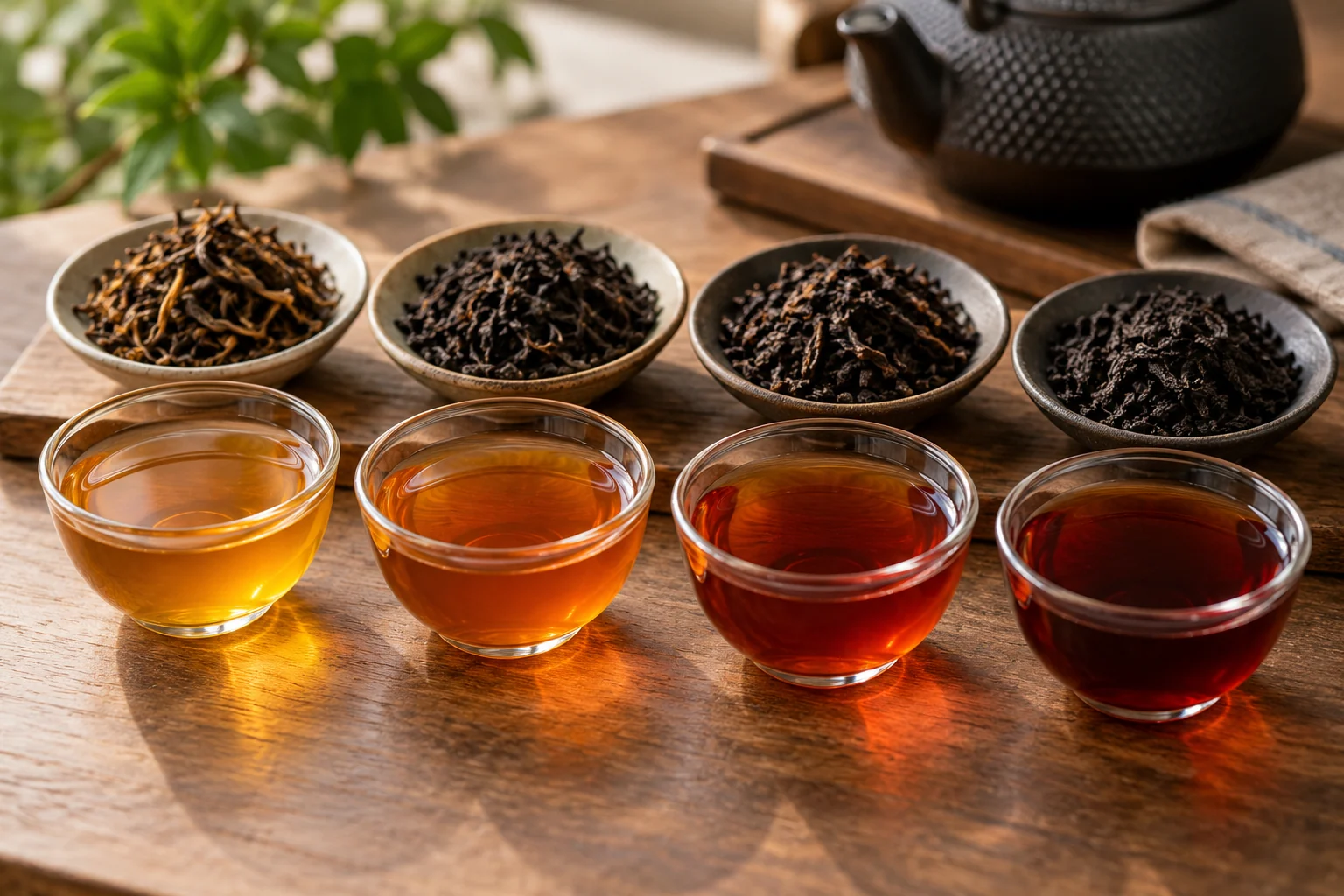
Black tea is not one flavor. It is a broad family of teas made from Camellia sinensis leaves that are generally allowed to oxidize much more extensively than green tea and most oolong tea before final drying.
That shared processing direction can create darker leaf and a deeper cup, but it does not make every black tea taste the same.
An Assam can be strong, malty, and full-bodied. A Darjeeling can be lighter, aromatic, brisk, and highly seasonal. Teas sold as Ceylon can range from bright and delicate to deep and powerful because Sri Lanka contains several distinct growing regions and elevations. Chinese black teas can add still more directions, from cocoa and dried fruit to smoke, honey, malt, or floral character depending on the tea.
The useful question is not simply, “What does black tea taste like?” It is:
Which black tea, from where, made how, and harvested when?
What makes black tea “black tea”?
Green, oolong, white, and black tea all come from the tea plant, Camellia sinensis. Their differences come largely from cultivar, growing conditions, harvest, and what producers do with the leaf after it is picked.
For black tea, the broad production sequence often includes:
- Withering to reduce moisture and make the leaf more pliable.
- Rolling, cutting, or macerating to damage leaf cells and bring enzymes into contact with tea polyphenols.
- Oxidation under controlled conditions.
- Drying or firing to stop the reactions and stabilize the tea.
- Sorting and grading before packing, blending, or sale.
Tea-industry language has historically called the oxidation stage “fermentation,” but for ordinary black tea this is primarily enzymatic oxidation, not the same type of microbe-driven fermentation associated with foods such as yogurt or kimchi.
Research following polyphenols through black-tea manufacture shows catechins decreasing while oxidation products such as theaflavins form. Those chemical changes are part of why black tea develops its characteristic color, briskness, body, and aroma.
If you already read our guide to oolong tea, think of black tea as another processing family rather than a single recipe or flavor.
Why two black teas can taste completely different
Several variables can matter at once.
Origin and growing conditions
Elevation, temperature, rainfall, soil, and seasonal weather affect how tea grows. Even within one country, two districts can produce noticeably different cups.
Cultivar and plant material
Different cultivars and plant populations can have different aromatic and chemical potential before processing begins.
Harvest season
Some regions divide the year into named harvest periods or “flushes.” Seasonal changes can materially affect the leaf and the cup.
Orthodox vs. CTC processing
Orthodox manufacture generally keeps larger portions of the leaf intact through rolling and shaping.
CTC means crush, tear, curl. The leaf is mechanically processed into much smaller particles. CTC teas are often designed for fast, strong extraction and are common in robust breakfast blends and milk tea.
Neither label automatically means “good” or “bad.” They describe processing approaches that can serve different goals.
Leaf particle size
Smaller particles expose more surface area to water and can extract more quickly. That is one reason finely cut tea may brew a strong cup rapidly.
Brewing
Tea-to-water ratio, water temperature, steep time, agitation, and even the size and material of a tea bag can change the final infusion. Published research has shown that preparation variables can substantially alter soluble solids, caffeine, and polyphenol concentrations in the cup.
So when two people describe the same tea differently, the difference may not be only their palate. They may also have brewed it differently.
Assam black tea
Assam is one of the clearest places to begin because its classic profile is easy to recognize.
Tea Board India describes Assam tea as having a rich, deep-amber color with a full-bodied, brisk, strong, malty character. The region produces both orthodox and CTC teas.
In practical tasting terms, Assam can suggest:
- malt
- baked grain
- caramelized sweetness
- dark honey
- raisin or dried fruit
- cocoa-like depth
- a firm, brisk structure
That strength is one reason Assam frequently appears in breakfast blends and in teas intended to take milk.
But “Assam” is still not one exact flavor. Estate, cultivar, flush, grade, and processing can all shift the cup.
Who may like Assam?
Try Assam if you enjoy:
- a substantial morning cup
- black tea with milk
- malty or warming flavors
- stronger body rather than delicate florals
Darjeeling black tea
Darjeeling demonstrates why black tea cannot be reduced to “dark and strong.”
Tea Board India describes brewed Darjeeling as ranging from pale lemon to rich amber, with varying brightness, depth, and body. The Board uses descriptors including mellow, smooth, delicate, sweet, lively, dry, and brisk.
Darjeeling is also highly seasonal.
Very broadly:
- First flush teas from spring are often lighter and more aromatic.
- Second flush teas from early summer can become rounder, deeper, and more fruit-driven.
- Later-season teas can shift again in body and aroma.
The exact character depends on garden, season, cultivar, weather, and manufacture, so treat “first flush tastes like X” as a useful orientation rather than a guarantee.
Darjeeling also has protected origin rules. Tea Board India states that only tea meeting its Darjeeling origin and certification requirements can legitimately use the Darjeeling identity and logo.
Who may like Darjeeling?
Try Darjeeling if you enjoy:
- aromatic tea without heavy body
- seasonal variation
- briskness
- floral or fruit-driven character
- tasting tea plain rather than automatically adding milk
Ceylon black tea
“Ceylon tea” refers to tea from Sri Lanka, but it should not be treated as one flavor profile.
Sri Lanka has multiple recognized tea-growing regions, each with its own elevation, climate, and style. Sri Lanka Tea Board materials emphasize distinct regional tastes and aromas across the island.
For example:
- Ruhuna, a low-grown southern region, is known for strong, full-flavored black tea.
- Uda Pussellawa, in the hill country, is described by the Sri Lanka Tea Board as darker in the cup than neighboring Nuwara Eliya teas, with greater strength and a tangy character.
Other Ceylon regions can move toward brighter, lighter, more floral, or more structured profiles.
This makes “Ceylon” a geographic starting point, not a tasting-note shortcut.
Who may like Ceylon tea?
Ceylon is a good category to explore if you want to compare how elevation and district influence tea while staying within one country of origin.
It also appears frequently in breakfast teas and flavored blends because many Ceylon styles have enough brightness and structure to remain noticeable alongside other ingredients.
Chinese black teas
China produces a wide range of teas that English-language sellers commonly categorize as black tea. In China, the category is often called hong cha, or “red tea,” referring to the reddish color of the liquor rather than the dry leaf.
Common examples you may encounter include:
Dian Hong
Black tea from Yunnan, often made with large-leaf tea material. Depending on grade and production, Dian Hong can suggest malt, cocoa, honey, dried fruit, earth, or spice.
Keemun
A well-known Anhui black tea style. Examples can range from light and aromatic to deeper, winey, cocoa-like, or gently smoky depending on grade and producer.
Lapsang Souchong
A Fujian black tea style famous in international markets for smoked versions. Not every tea sold under the broader historical name is equally smoky, so check the producer’s description rather than assuming every Lapsang will taste like a campfire.
Chinese black teas are a useful next step if most of your experience has been with breakfast blends, because they can show how aromatic and nuanced black tea can be without milk or flavoring.