Chamomile has one of the strongest reputations of any bedtime herb.
That reputation is older and broader than the clinical evidence.
A warm cup of chamomile can absolutely be part of a relaxing evening routine. It is naturally caffeine-free, widely available and generally safe in normal food and tea amounts for most people.
What it cannot honestly promise is guaranteed sleep, anxiety relief or treatment for insomnia.
The research is interesting, but the result depends on what was studied: ordinary tea, standardized extracts, capsules, specific patient groups or mixed herbal products are not interchangeable.
The short answer
Chamomile tea is a reasonable evening beverage if you enjoy it and tolerate it.
Research suggests chamomile may improve some measures of sleep quality in some groups, but evidence for chronic insomnia is not conclusive. Preliminary studies of chamomile extracts also suggest possible benefit for generalized anxiety disorder, but that does not establish an ordinary cup of tea as an anxiety treatment.
The safest takeaway is simple:
- use chamomile as a caffeine-free ritual, not a prescription substitute
- do not assume extract studies apply directly to tea
- watch for allergy and medication-interaction issues
- seek proper care for persistent insomnia, anxiety or other symptoms
For a broader evening-beverage comparison, see our Tea for Better Sleep guide and Tea for Relaxation guide.
What is chamomile tea?
“Chamomile” can refer to more than one plant.
The National Center for Complementary and Integrative Health focuses primarily on German chamomile (Matricaria recutita, also called Matricaria chamomilla or Chamomilla recutita). Roman chamomile is a different species and should not automatically be treated as identical in research or safety claims.
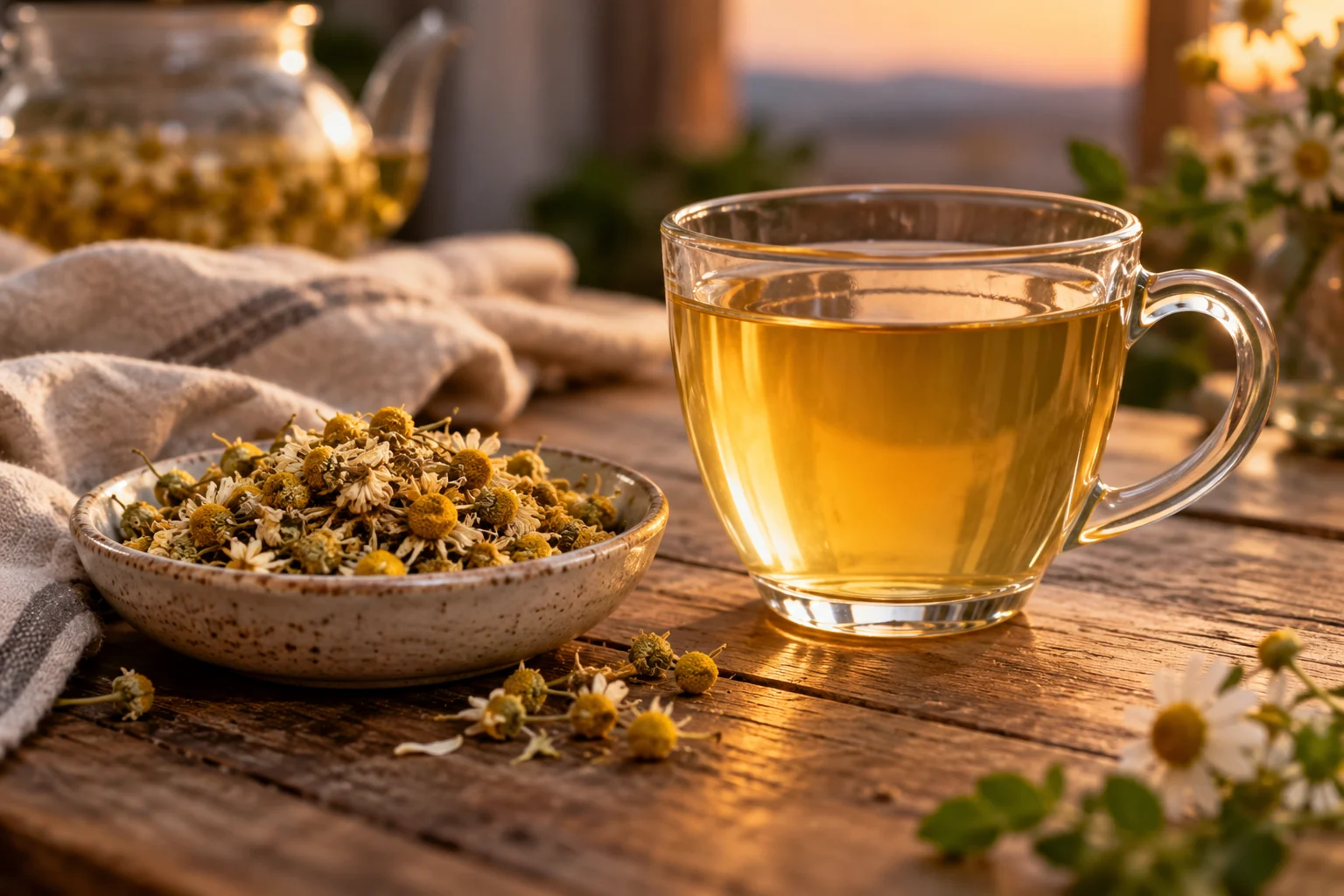
The familiar tea is usually made by steeping dried chamomile flower heads in hot water.
Because chamomile is not made from Camellia sinensis, it is an herbal infusion, not a true tea in the botanical sense. It is naturally caffeine-free unless blended with a caffeinated ingredient.
That caffeine-free profile is one practical reason it works well in an evening routine regardless of whether it produces a direct sedative effect.
Does chamomile tea help you sleep?
The answer is possibly for some sleep-quality measures, but the evidence is not strong enough to call it an insomnia treatment.
A 2024 systematic review and meta-analysis included ten clinical studies with 772 participants. The pooled analysis found an improvement in Pittsburgh Sleep Quality Index scores, and several studies reported improvements in falling asleep or nighttime awakenings.
But the same review found important limits:
- sleep duration did not clearly improve
- sleep efficiency did not consistently improve
- daytime functioning measures did not improve
- the studies used different populations and preparations
- statistical heterogeneity was high for the pooled sleep-quality result
- objective sleep measures were limited
That is a much more cautious conclusion than “chamomile makes you sleep better.”
It suggests a possible signal worth studying, not a guaranteed effect for every person drinking a grocery-store tea bag.
NCCIH remains conservative and says clinical evidence is not conclusive enough to establish chamomile as an insomnia treatment.
Tea is not the same as an extract or supplement
This distinction matters throughout chamomile research.
Clinical trials may use:
- standardized chamomile extract capsules
- specific measured doses
- concentrated preparations
- tea or infusion
- aromatherapy preparations
- multi-herb combinations
Those forms can deliver very different amounts of plant compounds.
If a study found an effect from a standardized extract, you cannot simply assume one cup of tea produces the same dose or result.
That does not make tea useless. It just means the claim needs to match the preparation.
For everyday use, chamomile tea is best framed as a pleasant caffeine-free beverage with limited but interesting clinical evidence, not as a pharmaceutical substitute.
What does the research say about anxiety?
Chamomile has also been studied for anxiety, particularly generalized anxiety disorder.
NCCIH says some preliminary studies suggest a chamomile dietary supplement might help generalized anxiety disorder, but the findings are not conclusive.
A 2019 systematic review found mixed results. Some generalized-anxiety measures improved in small trials, while state-anxiety outcomes did not show a clear benefit.
That distinction is important because “anxiety” is not one outcome and the evidence often comes from concentrated oral preparations rather than ordinary tea.
So the responsible claim is not “chamomile tea relieves anxiety.”
It is: some chamomile preparations have shown preliminary signals in anxiety research, but ordinary tea has not been established as a treatment for anxiety disorders.
If anxiety is persistent, severe or interfering with daily life, tea belongs beside proper support rather than in place of it.
Why chamomile can still feel relaxing
A beverage does not need to function like a drug to be useful.
A chamomile routine can create several low-stimulation cues at once:
- no caffeine
- warm temperature
- floral aroma
- a short steeping pause
- a repeated evening habit
- time away from work or screens
Those elements can make the drink feel calming even if the direct pharmacologic effect is small or uncertain.
That is not “just placebo” in a dismissive sense. A predictable wind-down routine can be valuable on its own.
Our Tea and Mindfulness guide takes the same approach: use the beverage as a sensory anchor without turning it into therapy.
How to brew chamomile tea
Start with the product directions because flower size, cut and blend strength vary.
For loose dried chamomile, a simple starting method is:
- Use roughly 1 to 2 teaspoons of dried flowers per 8-ounce cup.
- Add freshly boiled water.
- Cover the cup or pot while steeping to help retain aroma.
- Steep around 5 minutes, then taste.
- Extend the steep if you want more intensity.
- Strain and drink when comfortably warm.
Chamomile can become more intensely floral and slightly bitter with a longer steep. Adjust for taste rather than treating one brew time as medicinal dosing.
If you use a tea bag, the manufacturer’s recommended steep is usually a sensible starting point.
Does stronger chamomile work better?
There is no good reason to assume that making a dramatically stronger cup produces a stronger clinical effect.
Taste strength is not the same as a validated therapeutic dose.
A darker infusion may simply mean more extracted plant material and a more intense flavor.